
How Awake Surgery and Precision Mapping are Preserving Quality of Life for Patients with Brain Tumors
Key Takeaways For Busy Providers
- Patients with brain tumors are living longer, making preservation of neurologic function essential.
- Awake craniotomy with precision mapping enables maximal safe resection, especially for tumors near language or motor areas.
- Advanced imaging (fMRI and tractography) improves surgical accuracy and helps protect critical brain pathways.
- Early neurosurgical consultation for brain masses can guide optimal timing and approach, supporting downstream therapies and long-term outcomes and preserving the neurological functions patients need for meaningful survival.
Patients are living longer with primary brain tumors and brain metastases thanks to better multimodal treatments. Recent systematic reviews of real-world data suggest that 2-year and 3-year overall survival rates have roughly doubled for patients with glioblastoma since 2005. Functional outcomes matter now more than ever.
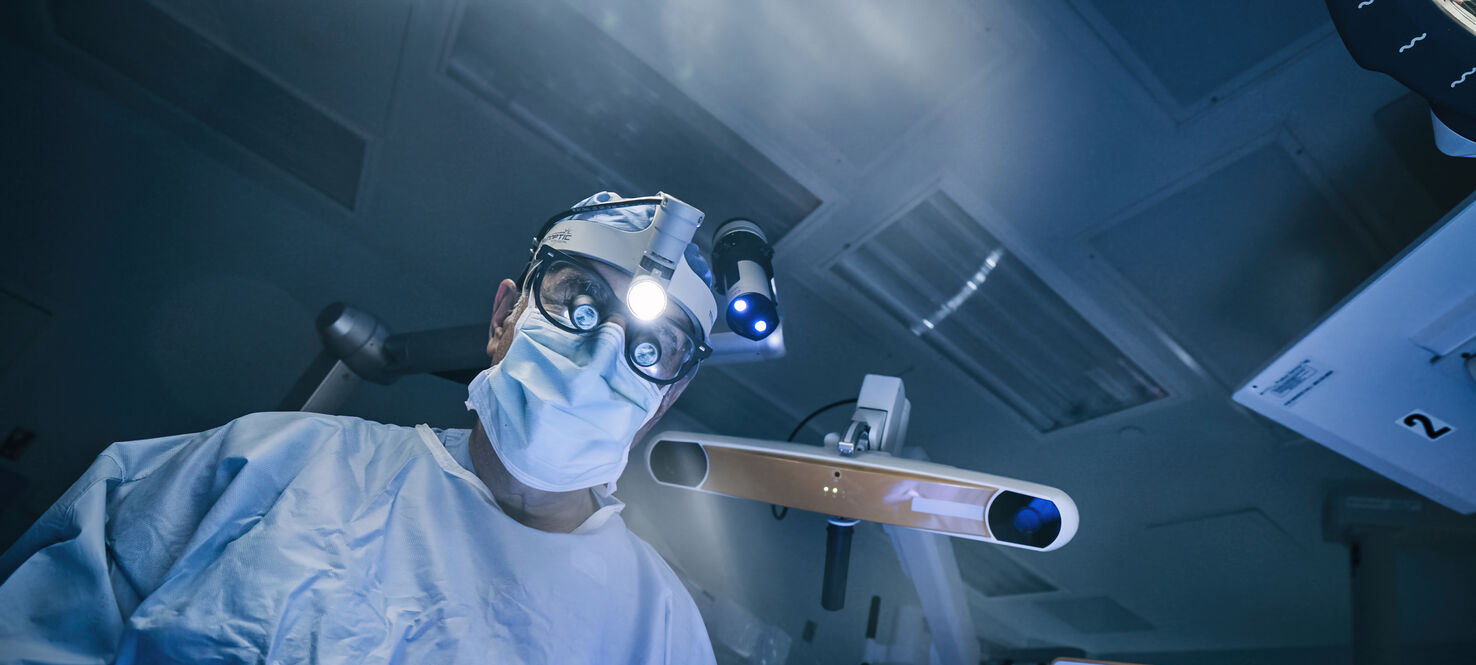
Awake craniotomy surgery integrating advanced technology is the function-preserving solution in this new era of longer survival. For tumors in eloquent areas, this approach enables safer resection. It allows patients to remain candidates for the full spectrum of modern neuro-oncology treatments that are driving these survival improvements.
Awake Craniotomy Enables Optimal Oncologic Care
A gross total resection (GTR) improves 1-year survival by 61% and 2-year survival by 19% compared with subtotal resection, and awake craniotomy, performed with the patient fully awake and interactive, is the best strategy to achieve GTR, especially for tumors close to language and movement areas.
An awake craniotomy is the preferred first option for malignant brain tumors because if you remove as much of the tumor as safely possible, the outcomes will be better. It's usually used for tumors that are close to areas of language and movement.
Dr. Arnold Etame, Neurosurgeon, Moffitt’s Neuro-Oncology Program
Awake craniotomy is not a standalone procedure; rather, it enables patients to benefit from other modern therapies downstream by decreasing neurological deficits.
Tumor Complexity Meets Surgical Expertise
The complexity of brain tumors demands both high case volume and subspecialized expertise that extends beyond technical proficiency. Dr. Etame’s entire career has been focused on researching and overcoming the challenges of treating glioblastoma, including his neurosurgery residency at the University of Michigan and his time at the University of Toronto’s renowned Labatt Brain Tumour Research Centre.
Over the past 14 years, working at Moffitt has allowed Dr. Etame to both treat and study brain tumors while improving patient experience and outcomes. He has since developed a robust awake brain surgery program at Moffitt in parallel.
Experience matters particularly when tumors involve critical language or motor areas. A 27-year analysis of awake craniotomy outcomes demonstrated extremely low complication and failure rates. However, achieving these results requires surgeons who regularly perform high-risk resections in the eloquent cortex.
Advanced Technology
Modern awake craniotomy integrates advanced technologies that have revolutionized precision and safety. Functional MRI and DTI tractography provide detailed neuro-navigation, allowing surgeons to plan approaches that avoid critical pathways. Using tractography, which essentially maps key white matter fibers for brain function, surgeons can navigate the brain more precisely.
Tractography tells surgeons where critical white matter fibers for movement, language and vision are located relative to the tumor and, when combined with functional MRI, provides insight into both function and structure. These technological advances enhance surgical judgment by creating a comprehensive picture that guides every aspect of the resection.
Moreover, intraoperative MRI (iMRI) technology, as well as fluorescent guided resection with 5-ALA, are technologies that can enhance the extent of tumor resection.
The Art of Patient Selection
Knowing when not to recommend awake craniotomy is as critical as knowing when to proceed. Patient selection extends far beyond tumor location to include psychological readiness, communication ability and physiological stability.
"We generally make sure they are comfortable and learn where their stress levels lie," explains Dr. Etame. The procedure requires establishing a relationship of mutual trust between the patient and the surgical team.
While awake brain tumor surgery can be safely performed with extremely low complication rates across diverse patient populations, success depends on careful assessment of each patient's ability to participate meaningfully in the intraoperative testing that makes the procedure effective. The goal is a successful awake procedure that achieves optimal resection while preserving function.
Partnership in Complex Care
The shift of brain cancer treatment from survival-focused to function-preserving care requires a fundamentally collaborative approach. Moffitt’s neurosurgeons work closely with larger treatment teams to create individualized, multispecialty plans that consider the patient's entire treatment journey.
This partnership extends to referring physicians as well, to enhance community care relationships through subspecialized expertise. Community physicians bring essential insights about their patients' overall health and treatment goals, which inform surgical strategy discussions.
For patients with brain tumors, Moffitt's surgical consultation makes early discussions accessible when they can have the greatest impact on treatment planning. We’re happy to review patient imaging of any brain tumor or discuss whether an awake approach may improve surgical safety or downstream treatment options.
To refer a patient for a neurosurgical consultation, start the process using our online form or reach out to our Liaison team for assistance at Physician.Relations@Moffitt.org.

 Medically reviewed by Dr. Arnold Etame, neurosurgeon, Neuro-Oncology Program.