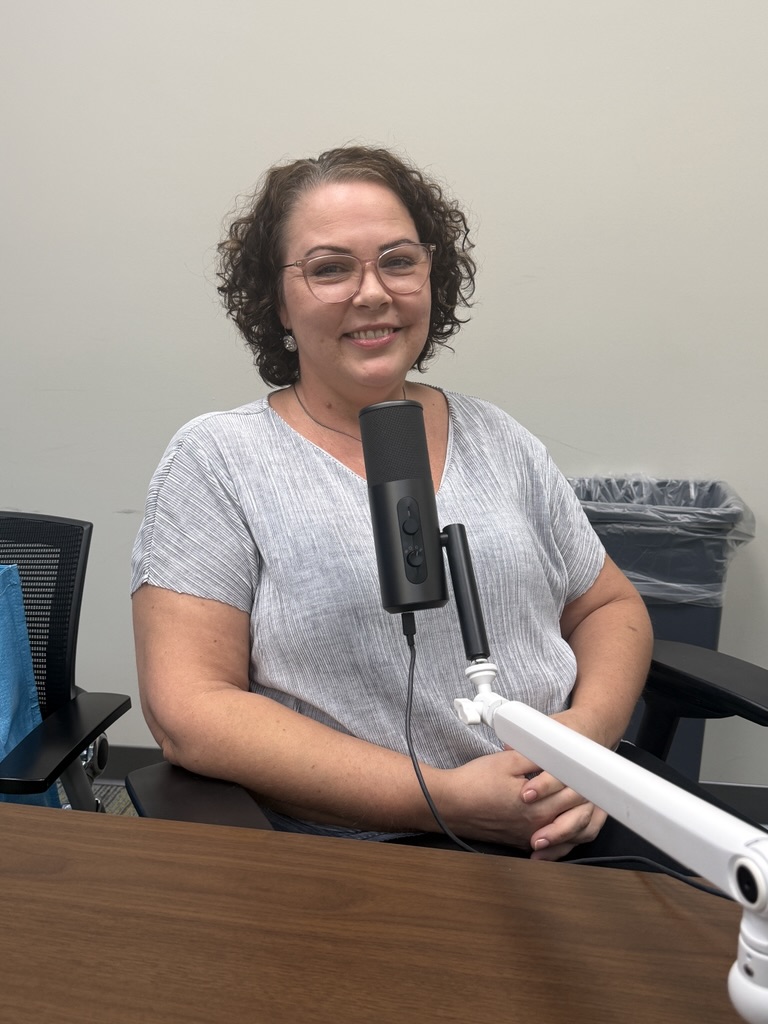
Heidi Nash: Where I Was Meant To Be
A Special Series from PEP Talks
Who Are The People In Your Neighborhood?
We often tell the stories of our patients, but behind every Moffitt patient experience is someone who shows up each day with compassion, purpose, and heart.
So… who are the people in your neighborhood?
- The teammate down the hall who always goes the extra mile.
- The quiet hero working behind the scenes.
- The one whose story has shaped the way they care for others.
In this new series, we’re turning the spotlight inward, sharing the stories, the “why,” and the heart of the people who make Moffitt what it is.
And here’s where you come in: We want you to introduce us.
Who do you know that we need to meet? Email us at peptalk@moffitt.org and tell us about your neighbors.
Because someone in your neighborhood has a story worth telling… and we can’t wait to hear it.
There are moments in life when everything changes. For Heidi Nash, that moment came not once, but twice. The first was hearing the words "you have breast cancer." After months of treatment, surgery, and radiation, she believed the hardest chapter was behind her. Then, just over a year later, she learned the cancer had returned as Stage IV metastatic breast cancer.
But this isn't just a story about a diagnosis.
It's the story of finding hope in unexpected places. Of discovering extraordinary compassion in the middle of overwhelming uncertainty. Of becoming part of the very team that helped carry her through.
Today, Heidi shares her journey from patient to Moffitt team member, reminding us that healing isn't found only in medicine; it's also found in people.
What You'll Learn From Heidi
- A smile, a calm voice, or simply taking the time to listen can completely change a patient's experience.
- Compassion isn't limited to healthcare professionals; every interaction, from security to scheduling to leadership, helps shape how patients experience their care.
- Sometimes healing begins when patients know it's okay to be scared, angry, or overwhelmed.
- Experiencing Moffitt as both a patient and a team member gave Heidi a unique understanding of what compassionate care truly looks like.
- Even when a disease can't be cured, life can still be fully lived. Heidi reminds us that while metastatic cancer may always be part of her story, it doesn't define the way she chooses to live each day.
For more stories, search for "Pep Talks with Moffitt" wherever you get your podcasts, or tune in and subscribe via our show page.
Podcast Transcript
So my name is Heidi and I work in the senior Adult oncology program. My journey that led me to Moffitt actually begins about three years ago. So three years ago I found out that I had stage two breast cancer. Um, I was getting treatment at another local cancer facility and we did all the things. We did four months of chemo, and then we did a bilateral mastectomy followed by thirty rounds of radiation. It was a rough year, but in ten months from start to finish, they told me that I was in remission. So I felt great and we just continued on some maintenance medications, went about our business with regular checkups,
About a year and a half later, I started having some hip pain. And so after a few months of it getting progressively worse, I talked to my oncologist and said, I really need to get a scan. All my labs were perfect, just as they were the first time, but I really felt in my gut that something was wrong. So we did a PET scan in July of 2025, and it came back as stage four metastatic breast cancer. It was in my pelvis, my femur, my shoulder, my lymph nodes, and both lobes of my liver. That was a tough pill to swallow. It really shook up me. It really shook up my family. And, um, you know, we just kind of got to a point where we had to take it one day at a time. What else could you do?
I started feeling like I needed more from my care team, and I knew that I was facing the biggest challenge of my life. So after some discussion with my husband and my kids, we decided to go where we felt was the best, which was Moffitt. And so we reached out and they got back to me right away. I had an appointment in less than two weeks with a new oncologist who was wonderful. So I met with Doctor Armaghani and she was fantastic. She spoke very slowly, calmly. We were so overwhelmed and she took notes during our meeting so that I didn't have to. And what a gift that is when you are going through the scariest thing of your life. So we left there feeling really good about the hands that we were now in.
The support that I got from Moffitt still was something I've never experienced before. And every time I came in, every single person that I encountered was so warm, so welcoming and just never made me feel like they were just here doing their job. They made me feel like they were here because they wanted to take care of me and everybody else who was there. Even the security guards, the front desk people, the, you know, people that are checking you in, whether it's for lab draws or scans. Everyone has a smile and nobody makes you feel rushed anywhere at any time. And you know, if you get your appointments mixed up, they help you fix it. And if you need to change an appointment, they help you do that. And even the people that call you, whether it's from scheduling or if you call into scheduling, you can hear them smiling on the phone.
We finally started chemo. And from day one, my chemo nurses just were wonderful. And what I loved was you have your own little private space. And that is something I didn't have before and it just gives you that kind of sense of security that I'm in my own little bubble. And, you know, my nurses are here for me. The techs are here for me. And it wasn't a cramped little space either, like you had a nice space where you could just get your treatment and feel whatever you needed to feel. And they all supported that. Every nurse that I've dealt with, they never they never show up with all the “just stay positive, stay positive, stay positive” …because sometimes you don't want to stay positive. Sometimes you just want to be angry or frustrated or sad. You just want to break down. And they encourage you to feel all your feelings here. And I love that they're so open about it. And there's so many resources that if you are feeling in distress or just want to talk to somebody, any single person you interact with here can steer you to somebody that can help you.
We've been going through chemo since the end of September of 2025. We’ve had some PET scans that have come back good. I've had two scans that the first scan I had this year actually showed no active disease. And which was shocking to me because my cancer had evolved from hormone positive to triple negative. And I know that triple negative is a lot harder to treat. But Doctor Armaghani was so smart and she just she ordered multiple tests on my liver biopsies to make sure that she knew exactly what she was dealing with. And she put me on the right regimen. And I will forever be grateful for that. Being stage four is hard because, you know, you're never going to beat it. You can treat it and you can manage it, but you're never going to beat this one. It's always going to be with you, but you still just live your life and you say, I may only be able to manage my cancer, but I'm going to manage it the best way that I can. And I think attitude plays a lot with that. I've always been a pretty positive person. And so a lot of people don't see, you know, sometimes I do go through those hard times, but I think just having a smile for people is important. Sometimes people can't find it, can't find their smile that day. So share yours. That's kind of my philosophy. If you can't see the sunshine, be the sunshine.
But, um, so while I was out recovering from my hip surgery, I was out of work for quite a while and ultimately lost my job. And so I said, okay, well, we've got to find something. It's a very overwhelming position to be in, especially if you're like me, where I was, you know, the health benefits provider for my family. So that was a lot of loss at once. We lost my income, we lost my, um, our health insurance. And so there's so many things to factor in there. I think that when you're trying to navigate, okay, what, what am I going to do now? You just, you have to think about what, what do I need? What am I going to be able to do? Because the side effects, you don't know how they're going to affect you. Um, for me, a part time job was the perfect solution. And so, you know, is it difficult to manage losing half of your income that you were used to? Of course it is. But I know that it's the best fit for me because it allows me to have ample time to make my appointments with Moffitt and they are incredibly great about working around my work schedule
And all I kept thinking like the whole time I was going through treatment, which I'm still going through, is how great of a place this would be to work. Like, not only do I get amazing care here, but it's such an amazing team of people and it's such a, an incredible organization that truly cares about its patients. And so I just kept searching and searching and searching and searching the job postings and found a position that for my situation and my needs so incredibly, perfectly that I feel so blessed to have gotten the opportunity to work at Moffitt and to be part of such an incredible team. Um, even though I don't have direct patient care, I know I work on the back end. That also always helps patients. And as a nurse, that means something to me. Um, I just, I feel really blessed to be at the best place as a patient, but also to be at the best place as an employee. And I feel proud to say that I work for Moffitt.
I think being a patient has definitely impacted how I perform my job as a team member here at Moffitt. Um, you know, being a patient, obviously you have the one perspective of these people are here to take care of me. And then on the flip side of that, being a team member, I'm here to take care of people. So how you blend those two and merge those two is so unique. And I think having both perspectives allows me, this is going to sound weird, but it allows me to be better at both. I mean, I can be a better team member because I can help patients in a way that I know that they need to be helped because I've been there. And it also helps me feel like I'm a better patient because I know what the team members are going through. And so on the days when they're busy and they're backed up, I don't want to add to their stress because I know that they're doing everything in their power to take care of their patients..
Wen I first started at Moffitt, which really was not that long ago, my very first day I got admitted to the hospital. So fortunately, I had worked my shift that morning, and then I went to urgent care for some swelling in my leg and they admitted me overnight. And so I missed the next day of work. And I thought, oh no, okay, we're we're going to be okay. It's just one day. And I worked a couple more days. And then my oncologist sent me back to urgent care because the swelling was getting worse. And I was in the hospital for thirteen days. And so finally got out of there, worked for two weeks, and was back in the hospital for a week. So the amount of stress that I had thinking I just got this most perfect job and I'm going to lose it Because I can't get out of the hospital. But I work with the most incredible team in senior adult oncology. And, um, one of the main doctors that I work with, Doctor Extermann, was incredible. So my thirteenth day of a thirteen day stay at the hospital, she actually came to visit me. Now, I'd really only had one interaction with her outside of my interview because I was that new and she's so busy, but she came just to make sure that I knew my job was safe. And I just cried because the amount of pressure that took off of me, um, it really allowed me to not worry and to focus on my healing. And I was so grateful to her for that. And when I ended up in the hospital again, she came again and she brought another team member with her. And just to cheer me up, say hi and let me know everything was okay. So, the support that I've gotten from them has been incredible. And if I need to, you know, leave early for a doctor's appointment or if I need to, you know, just clock out in the middle of my shift and run downstairs for a doctor's appointment and then clock back in and get back to work they are okay with it. They fully support me doing what I need to do to care for myself as long as my job gets done. And, you know, they barely know me, but they're still asking about me. How are you doing? How's treatment going? And they genuinely make me feel like they care. And that's so incredible. And I hope that the leaders of Moffitt know how important that is to support their team members like that, and to reassure them that you are an important part of the Moffitt family, and you need to take care of you so that you can take care of others. But we care about you, so we will make sure that you have access to whatever you need to be able to get the appointments you need or the treatment you need, or the care you need without worry, without stress of, you know, or without worrying about losing your job. You know, your job is safe because you work for Moffitt. And Moffitt cares.
When I look at the big picture. My cancer. My treatments. My employment. All of that and me ending up at Moffitt. I'm a firm believer in everything happens for a reason. And while I don't love having stage four cancer, my stage four cancer is what led me to Moffitt. And this is where I'm meant to be, both as a patient and an employee. And I am proud of that, and I feel blessed to be here