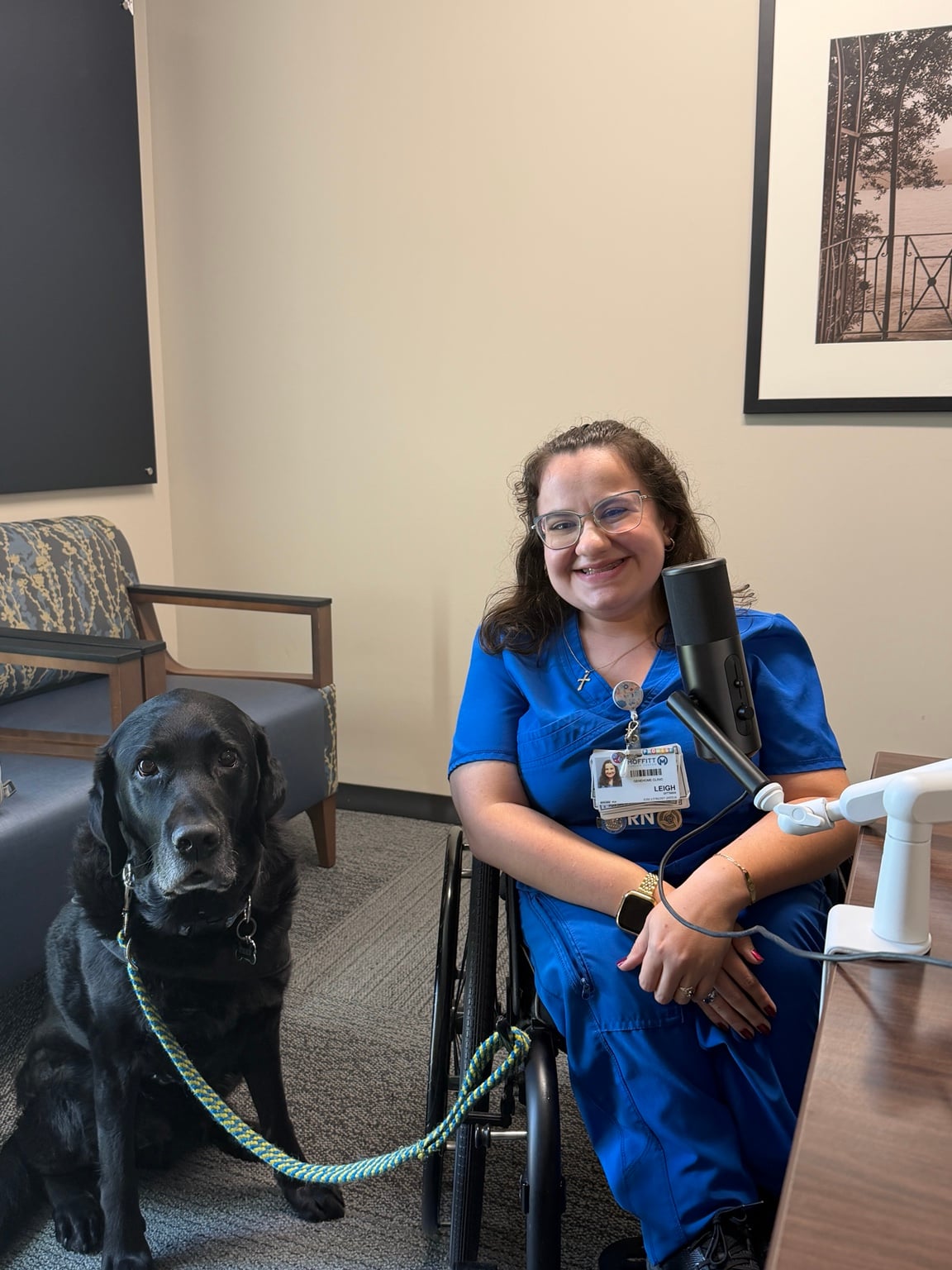
Leigh Dittman (and Nerf): Partners In Purpose
A Special Series from PEP Talks
Who Are The People In Your Neighborhood?
We often tell the stories of our patients, but behind every Moffitt patient experience is someone who shows up each day with compassion, purpose, and heart.
So… who are the people in your neighborhood?
- The teammate down the hall who always goes the extra mile.
- The quiet hero working behind the scenes.
- The one whose story has shaped the way they care for others.
In this new series, we’re turning the spotlight inward, sharing the stories, the “why,” and the heart of the people who make Moffitt what it is.
And here’s where you come in: We want you to introduce us.
Who do you know that we need to meet? Email us at peptalk@moffitt.org and tell us about your neighbors.
Because someone in your neighborhood has a story worth telling… and we can’t wait to hear it.
Sometimes the people we pass in the hallway every day have stories that would completely change the way we see them, if we only took the time to ask.
Leigh Dittman is an ambulatory nurse in our Genome Clinic, and wherever Leigh goes, her faithful service dog, Nerf, is never far behind.
But behind that familiar partnership is an extraordinary story of resilience, determination, and the people who believed in her long before she believed in herself.
Leigh was born with osteogenesis imperfecta, better known as brittle bone disease, and has spent much of her life on the other side of healthcare. Today, she brings those experiences with her into every patient interaction, reminding us that compassion isn't just something we do... it's something we become.
What You'll Learn From Leigh
- How one nurse's personal health journey shaped her approach to patient care
- The life-changing role a service dog can play in fostering independence and confidence
- Why empathy and lived experience can strengthen the connection between patients and providers
- Common misconceptions about service dogs and what patients and caregivers should know
- How resilience, determination and support can help overcome barriers in healthcare and life
For more stories, search for "Pep Talks with Moffitt" wherever you get your podcasts, or tune in and subscribe via our show page.
Podcast Transcript
So my name is Leigh Dittman. I am an ambulatory nurse here at Moffitt. I work in the Gene Home Clinic, which is currently based out of the McKinley campus. And the patient population that we follow are individuals with genetic mutations that put them at an increased risk for developing cancers. How I came to Moffitt is a different story.
I was born with osteogenesis imperfecta, better known as brittle bone disease. It is a genetic mutation, ironically enough that causes a collagen deficiency in the body, which leads to weak bones. It leads to a shortness of stature and other conditions that are impacted in the system that are collagen based. And so with that, in my life, I've had 46 fractures, 14 surgeries, countless hours of physical therapy, and infusions of a medication to increase bone density. So my life from day one has always revolved around the hospital. I was a Shriner's patient for majority of my life up until I was about 22. And that is where I received all of my care. And it was in Shriners here in Tampa that I fell in love with medicine.
I fell in love with healthcare and with the wonderful work that the healthcare force can do for individuals. And my nurses especially were such a huge impact on my life. I had wonderful nurses that knew me very, very well who would seek me out whether I had an appointment that day or not and I was in the building for whatever reason, they would come find me to come talk with me and to come see me. And with that, it really inspired a love of medicine and of health. I had nurses who would explain things to me before I have procedures. And so with that, it was just nursing was a no-brainer for me in my life. I think I was about six or seven years old when I first started saying I wanted to be a nurse. So that has dictated my whole life of what I was interested in school, getting into college. It was no question in my mind I wanted to be a nurse. Oncology was not the plan. Growing up, it was pediatrics. I wanted to be a pediatric nurse and care for other kiddos like myself. And then when I got into college and started nursing school, I quickly shifted my focus to I wanted to be a NICU nurse and work with little babies and make an impact on families like my own of, the scary reality of having a child born with a disability. What that can be is world shattering for families. And my family had a hard time at the beginning and I wanted to be a positive impact to those that were coming after me.
And so that was how I went into things. And then, the expression We make plans and God laughs. I had planned to be a NICU nurse and those doors didn't open. Instead, I applied to Moffitt kind of on a whim and within 24 hours got the phone call for an interview and it just continued from there. So I ended up as a nurse resident here, which is a baby nurse here at Moffitt. I have loved Getting to be a part of Moffitt, Moffitt was very close and personal to my family, and we've had many family members with different cancers. My grandfather especially was a big part of me feeling like I found my right place here at Moffitt. He was a patient when I was a senior in high school with pancreatic cancer, and so he did not live much longer. After diagnosis, it was about four months, but the care he received through Moffitt was incomparable. It was something that was really special and they took care of us as a family too. And so the day that I got the call for an interview was actually his birthday. And where I did my interview in person ended up being in the same clinic area that he was getting treatment when he was treated. So from day one, Moffitt has always felt like the right place. And I'm here 3 1/2 years later and loving what I do.
So when I was a, I think a freshman or a sophomore in high school, I had met someone else, an adult with brittle bone disease, same condition that I have, and she had a service dog. And it was such a cool experience to get to meet her, meet her service dog, and to hear their story. To be someone with a disability, everyone's disability is different. For me and my case personally, it's a lot of physical things. So using a wheelchair and navigating the world in a wheelchair is not always the easiest thing. And so from a very young age, all through school, I had a one-on-one aid, so an adult with me to make sure that I was safe, to make sure I was able to get from one location to another, to carry items for me and things of that nature. As I got into high school and had this experience with this individual, it was something where it was like, this is what I want for myself in the future. I don't want to be relying on someone else to be able to get from point A to point B. I don't want to have someone that I need help from. I'm good about asking for help when I need it, but the day-to-day, especially in high school, you're learning to be an independent person. And that was a big point in my life where that was a decision that had to be made. As I was going through high school, getting ready for college, nursing school, et cetera, I wanted to be able to do those things myself. So I started the process of applying for a service dog.
I received Nerf, my service dog, from Canine Companions. They're a nonprofit organization that's nationwide. and they train service dogs for individuals with disabilities. It's about a two-year process from start to finish from the initial application and phone call all the way to receiving the call that I was ready for team training. NERF was picked for me. So the way that Canine Companions works is with the application process, they collect information on you about your diagnosis, about what your life looks like, what your abilities are, who you live with, where you live, what does your life look like in regards to activity. And they will look at all of the hundreds of dogs that they have out in the world being trained by volunteer puppy raisers across the country. So Nerf was their top pick for me. They had a feeling that he would be the one to go home with me and Nerf was the dog that I would help with. It was two weeks before I started my first day of classes, my freshman year of college. So Nerf was my companion and my sidekick through the entirety of college and really was the key to making sure that I could go to college independently. He could pick up items that I dropped, whether it be my car keys, pencils, pens, notebooks. He was able to pull me in my wheelchair. So we were trying to hike it across Tampus. We were running late. He'd be able to pull to where we got a little bit more speed, which was always a good thing. He acted as a great buffer in crowded areas. People tend to give a little bit more space when they see him and I walking somewhere. So that was good for me for my safety. But also, socially, he was a great icebreaker. Everyone wants to know about Nerf. Everyone wants to talk about Nerf. They'll approach me. It's nice that it's about him and not about me. He's a big part of me being able to get through nursing school, whether it be the physical tasks or the emotional, you know, whether it was in college to where my life is now, he's a constant companion. He's been with me for, it will be 8 years in August, which is hard to believe. It feels like it's flown. And I really can't remember what life was like before Nerf, even if we're not taking out the tasks that he does, just his unconditional love and goofiness and just light that he brings him to a room. Everyone gravitates towards Nerf and he can't help it. I mean, he's just the best dog, but maybe I'm a little biased.
He's been a constant companion... I really can't remember what life was like before him
Having Nerf at Moffitt is definitely something that has been a journey to be able to do. Moffitt is very comfortable and able to have service animals for our patients. Having employees with service animals is a little different, so we've had to kind of navigate that together, but we've had to navigate things from the get-go. Moffitt hasn't had a nurse in a wheelchair before, so there's been a lot of learning from both sides to be able to find what works best. It is tricky at times because he is a service dog, right? The expectation is that he is here for me and he is here to make sure that I am able to do my job appropriately. So it is walking that line and advocating and having those educational moments of, you know, well, he's busy right now or he's working so he can't really be interacted with. There are times and moments where we're not. And so I will let Nerf say hello to anyone who is asking. I'm not a super big stickler on that because he's cute and cuddly and have you not say hello to him. So day-to-day, Nerf does not do too much interaction with patients. When we're in clinic or when I'm in clinic, He hangs out in our workroom. He has a crate in there that he is able to go take a nap in, which is nice. I think we all want that some work days. And that's really just so I have one-on-one attention with our patients. I'm able to focus on them and address their needs. It's also, we're in the ambulatory setting, so our clinic exam rooms are not always the biggest. And so if it's myself, the patient, if the patient has loved ones with them, if the patient is also using a mobility device like a wheelchair or a walker, the room can get crowded very, very quickly.
But one moment that really sticks out actually wasn't a patient at all, and I was actually off from working for the day. We had a family friend who was being treated here at Moffitt, and she had a pretty big abdominal surgery for her treatments, and she was over at the McKinley Hospital inpatient. And so after we got off of work, we went over across the bridge and went to go visit her. And Nerf is such a sweet, gentle soul. He could tell that she was not feeling well. She'd only had surgery, I want to say it was less than 24 hours when we went to go visit her. And so she didn't have a lot of mobility. Obviously a big abdominal surgery, you're not really going to be bending down. And so Nerf was very calm and gentle. because she really wanted to see him and to pet him. And so he met her where she was able to. And it's just one of those things where it's, whether it's somebody we're interacting with or myself and I'm hurt or I'm not feeling well, Nerf picks up on those things very, very quickly and meets you where you need him to be.
I think that today a lot of people are very familiar with service dogs. I think that a lot of the misconceptions are the nuances between a service dog and an emotional support animal and the fact that those are two very, very different things. Service dogs, service animals, they're protected by federal law to be able to go in public with their handler to public settings such as a hospital and to be with your handler. Emotional support animals are not. They are intended for at home and for emotional support at home. So that's something that I think a lot of people tend to get mixed up on those. And really what that is, the emotional support animals are out in public more than what they should be, which can cause problems for those of us that are true service animal teams. It causes a lot of pushback from public entities of is this animal allowed or not? There are instances where an emotional support animal who's not trained has had confrontations with service animals, and that can be a safety concern for both the service animal and for the handler. We have not had those situations here at Moffitt, thankfully, but for us and for what we do, the fact that he is trained, that he is able to do the tasks that he is intended to do, and then he gets up to move to shake or change positions, or we're going to leave. I get frequently, oh, I forgot he was even here. I'm like, that's the point. You should forget. He should be doing what he's supposed to do, and if he is not, he should be inconspicuous and out of the way. I feel really blessed and lucky that I have Nerf. He is the best dog, he is the best partner and I just am so grateful for him.
More often than not... people say, 'I forgot he was even here.' That's the point.
Being the patient, being the individual in the bed absolutely impacts how I interact with my patients when I'm the one in the scrubs and wearing the badge. It's something that you shouldn't forget the humanity of the person in front of you. shouldn't forget that they are someone's, you know, father, mother, sister, brother, daughter, son. They are an individual outside of the walls that you are meeting them in. I have many patients that Moffitt is their safe place, you know, out in the real world. They have to be brave. They have to be, you know, a strong face to their loved ones. They don't want to scare them. And when they get here to Moffitt, they feel safe to be able to voice their concerns and I want to be that person. And I feel very humbled and honored that I can be that person for our patients. And a lot of that stems from I've been the person myself and needing to feel that safety and to be able to talk about things.
It's something that you shouldn't forget the humanity of the person in front of you. shouldn't forget that they are someone's, you know, father, mother, sister, brother, daughter, son. They are an individual outside of the walls that you are meeting them in.
I think I'm just most proud if I look at everything that I've done. I think I'm just proud that I'm myself. It didn't matter what anyone else said. If I had an idea, if I had a vision of what I wanted, I went for it. And that can take me. So I'd say I'm proud of that. I'm proud that I believe in myself, but more importantly, to be able to do that, I had really good people around me to be able to do that. Family and friends, these and now coworkers. I feel like I repeat myself, but I just, I'm very blessed. I've lived a really good life and I am so fortunate to be able to do and hopefully make good impact on the world with other people too. Circumstances are hard. You can't change the barriers that are in front of you. All you can do is adapt. So if there is something that is blocking your way, if there is something that there is only one way that people know of, you have to figure out what that other way is. And that can be hard and it takes a lot of strength. And if you don't have a good support system, it's It seems impossible, but you have strength to be able to do it. You have to be willing to find it in yourself to be able to go through those things, to be a voice of dissent, to question why things are always done the way that they're done, and to be willing to stand out alone. It can be scary. And that's something that I've had to navigate. I was always the only kid with a disability in my class. I was the only nurse in a wheelchair to get through nursing school. I am the only nurse at Moffitt in a wheelchair. That is something that I take a lot of pride in, that I have been able to do that and to stand out there and to say that this is possible. But I know that I didn't do it on my own. It took my friends, my family, and my parents to be willing to back me up on those things. My parents never once tried to steer me into a different path. As soon as I said I wanted to do nursing, they were like, okay, so we'll do it. And that's something that I know would have been a lot harder. I'm speaking from a place of great privilege and I know that to have had the resources that I did to be able to do what I have done. And that's something that even without those, there is a way. It's a hard way. You have to find those ways around those circumstances, but it is possible.
Circumstances are hard. You can't change the barriers that are in front of you. All you can do is adapt.
I feel like when you ask somebody, you know, how would you want to be introduced or, you know, how do you want people to know who you are? It's like a litmus test because it's how do you how do you describe yourself? I'd like to hope that if someone was introducing me that they would say that I am kind, that I am friendly, that I'm smart, compassionate, those are traits that I hope that I exude in my day-to-day life, that I am fiercely loyal, that I go above and beyond what anyone is asked to do. I might be a little bit type A, but hopefully for my patients, it's a good thing. So they're okay with me saying that I'm type A. I love to learn. I am such a learner at heart. And I care deeply about my family, my friends, those that I love, the patients that I get to care for, and that when I leave this world that I've let into a better place. That's what I want.