
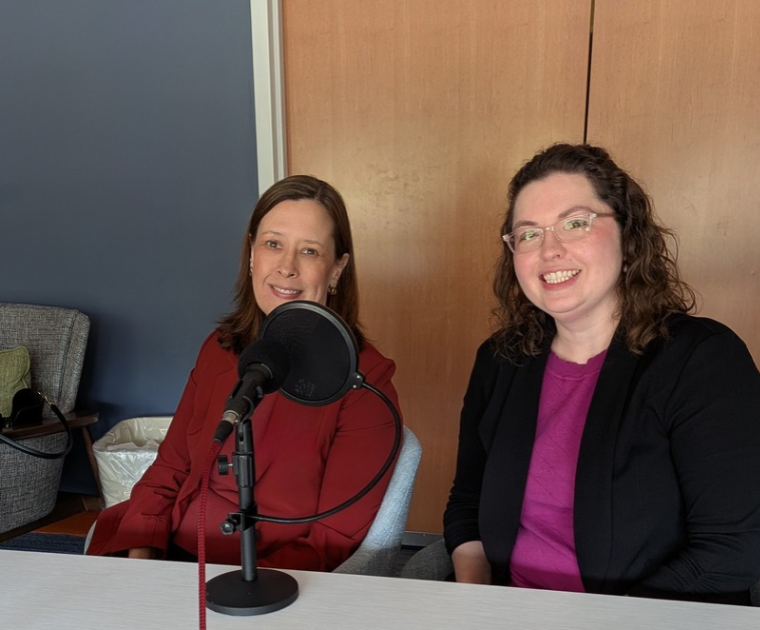
Listen in: Dr. Jenny Vidrine and Ms. Allie Nguyen - Research in our Community
October 21st marks the beginning of National Health Education week, and what better way to celebrate that than by speaking with the health educators and scientists who are bringing research out of the labs and into the local communities?
Enter Dr. Jenny Vidrine and Allie Nguyen . Through leading Moffitt’s COE-SCORE initiative, they facilitate the development and maintenance of meaningful and mutually beneficial research partnerships between Moffitt Cancer Center faculty and local community organizations including primary care clinics, health systems, and social service organizations. These partnerships allow community members to participate in cancer prevention and survivorship studies while attending the places where they have relationships and feel at home.
Transcript
[00:00:00] Intro music
[00:00:11] Brandon: Hello, hello, hello, listeners. It is September, which means it is time to launch a new season of Cancer in Our Community, where we're having conversations about better outcomes for all members of our community. For those of you who are new to this podcast, I am Dr. Brandon Blue. I'm an oncologist in the Department of Malignant Hematology at Moffitt Cancer Center in Tampa, Florida, and I'm also your podcast host. Now, as a podcast that is produced by Moffitt's Office of Community Outreach and Engagement, today's episode covers a research topic that is close to home for our team.
Before we get to our exciting topic, really, I wanna introduce today's guests. First, we have Jenny Vidrine and Allie Nguyen. How are you both doing today?
[00:01:01] Allie: Excited to be here.
[00:01:02] Jenny: Doing great. Really pleased to be here and talking with you this morning.
[00:01:05] Brandon: Wonderful. So I'm gonna give our audience a little bit of a background about who you ladies are and really talk about kind of why we're interviewing you today.
First up, we have Dr. Jenny Vidrine. She is a tenured senior member and distinguished scholar in the Department of Health Outcomes and Behavior. She is also an assistant center director for research community partnership within COE at Moffitt, and a professor in the Department of Psychology, College of Arts and Sciences, and Oncologic Sciences at the Morsani College of Medicine at the University of South Florida.
She has more than two decades of experience in health behavior changes research with a focus on tobacco cessation. Specifically, her research focuses on investigating associations between health risk perceptions and smoking health risk communications and the development, evaluation, and dissemination of tobacco cessation interventions targeted to specific populations, including cancer survivors.
Wow, Dr. Jenny Vidrine, you've done a lot, and that was a mouthful. So I'm really excited to hear from you today. But, next up, we also have Allie Nguyen, who has a master's in public health and is a master certified health education specialist. She previously spent more than nine years in the Florida Department of Health in Hillsborough County, including leading the Office of Minority Health. Allie currently serves at the COE, as a research partnerships program manager, where she is strengthening research partnerships that elevate community voice and engagement.
Now that I've said a little bit about these wonderful people, it's time to dive in a little bit more and have them talk to us more about exactly what they're doing and about the project that's happening. As a sports fan, I'm going to title this thing the COE-SCORE. Now, most people have never heard of the COE-SCORE.
So the first question is, ladies, what exactly is the COE-SCORE?
[00:03:17] Jenny: We appreciate you asking. So COE-SCORE is an initiative within our Office of Community Outreach and Engagement here at Moffitt, and it's an acronym that stands for Support for Community Organization Research Engagement. And I work really closely with Allie here in leading this initiative.
Our overall purpose is to improve health through fostering community academic partnerships designed to support scientifically rigorous and impactful research across the entire cancer continuum.
And this really includes everything from cancer prevention and screening through cancer treatment and longer term cancer survivorship. And we really work to ensure that we prioritize the needs of the community organizations we work with. And partnering closely with these groups provides Moffitt faculty with incredible opportunities to conduct their research in real world settings.
And we believe that this community engaged approach to research ensures that our research findings are generalizable beyond the tight confines of research institutions. It also helps us to ensure that we enroll the people most likely to be impacted by cancer in our research studies.
[00:04:23] Brandon: So it sounds like really what we're trying to do here is to bring together the science, the research, the community, the problems in the community, the people who know the most about the community, and really make it so that we all work together for the same goal. Is that correct?
[00:04:40] Jenny: Absolutely.
[00:04:41] Brandon: Now, one of the questions that I had that comes to mind is, how do we know what is important in the community?
Sometimes we are here on our side, but how do we understand what's happening in the community for the people? Like, how do we know what the people want? And so you guys tell me, how does COE-SCORE assess or evaluate what the people's needs are?
[00:05:05] Allie: So, one of the things that COE does broadly, is works on a community health needs assessment.
So every three years, this is something that our office does where we're engaging stakeholders and community members, including representatives from the Patient Family Advisory Program and the TBCCN group, and so asking, you know, what are the priorities that we have around, you know, Hillsborough County, around our catchment area, around, uh, cancer care and cancer support.
And so that helps us to determine some key priorities each time; so things like survivorship, like health for all, education and outreach. That's just one of the ways that we're working on identifying, you know, what's important in our community. And certainly, researchers are clued in based on the partners that we work with as well, and the partners' priorities specifically.
[00:05:52] Brandon: You know, I'll tell you that this is something that is really not a part of a lot of our modern healthcare. The biggest problem that a lot of patients come to me as a doctor and say is that they don't feel heard, is that they feel like their voice doesn't matter. So it sounds like through this COE-SCORE program, we found a way to let the people's voice be known and actually do something about it.
So I'm really excited to hear more about this, but I think this is definitely a need that is really not done in a lot of places. So because this is somewhat of a unique thing, where did this idea come from? Like, who was the genius behind this who said this needed to happen? So can someone shed some light on exactly: where did this all get started?
[00:06:33] Jenny: Sure. So Moffitt faculty have a long history of conducting meaningful community-engaged research. What SCORE brings to that is some institutional support and infrastructure. Working with community partners is incredibly rewarding. It greatly expands the impact of, of our research findings. But it's challenging, and often we wanna partner with community organizations that might not have infrastructure to support research.
So let's say a faculty member is working on a grant application, and they wanna partner with a clinic. Well, they need to be able to characterize that clinic. This clinic serves X number of patients, and this is their racial, ethnic, and demographic breakdown. These are the health conditions they have. So we need to ask them to, to provide some of that preliminary information, and that requires time and resources.
We might also need people in the clinic, boots on the ground, enrolling people in studies, and sometimes organizations might have that infrastructure, and they might not. So we really work to listen and understand the needs of organizations. I think that's the most important thing we do is we ask people, "What are your needs? What are your priorities? And how can we, how can we help you collaborate on research that strengthens what we do and also adds value to your organization?"
[00:07:47] Brandon: Now, I'll tell you that when people hear the word research, a lot of things come into mind, or maybe nothing comes to mind, right? Because that's something that we may see televised but not really have a good sense of.
You know, typically on television, there's a guy in a lab coat who has these test tubes, and he's doing research, mixing a green bottle with a red bottle, and then something explodes or something, or people even from, you know, maybe high school chemistry might remember some experiment or the volcano that they made that kind of exploded.
But I'm not sure if that's the research that we're talking about here. Maybe it is. But could you shed some light on exactly when our listeners are hearing these words research exactly what that means to you?
[00:08:29] Allie: Sure. So, I can start off with that. So, you know, we talk a lot or work a lot with faculty in the Department of Health Outcomes and Behavior, and so a lot of what they're working on are modifiable risk factors, so health behaviors that you can change that would help prevent cancer, and also that help prevent other chronic conditions.
So we're talking about things like smoking cessation, healthy eating, physical activity, obesity, uh, prevention. We're talking about sexual risk behaviors, wearing sunscreen, kind of a lot of different things that we can do as individuals, right, to improve our health outcomes. And so we work with a lot of faculty and have worked with faculty, and see how we score on research like that.
So we’ve worked with Dr. Nate Parker, for example, on a pickleball intervention that was looking at physical activity, and so that was just... You know, that's one example of what that looks like. So he's- his lab is the community, essentially. He's out in the community at the YMCA, and that's his lab setting really.
Mm-hmm.
[00:09:27] Jenny: We have really good data showing that about 40% of cancers are directly attributable to lifestyle behaviors, and about 50% of cancer mortality. So changing these behaviors and living healthier lives has tremendous implications for preventing cancer, preventing cancer recurrence, second primaries, improving k- responses to cancer treatment.
But as we all know, these behaviors are hard, right? We all know we should be exercising five times a week and eating lots of fruits and vegetables and using sunscreen. In the real world, these behaviors are hard to change and hard to maintain these changes. So there's a whole science behind this, and that's what a lot of our faculty in Health Outcomes and Behavior and Cancer Epidemiology, that's their focus. So we work mostly with these types of researchers rather than basic science or traditional clinical trials.
[00:10:19] Brandon: Got it. You know, I'll tell you one thing that comes to my mind when you say these things is, again, I'm speaking from a cancer doctor's perspective. Whenever I sit across the table from someone and I tell them that they have cancer, one of the big things that they tell me is that they feel powerless.
Right? They feel like there's nothing that they can do, and so that's the number one question they ask me, "Well, Dr. Blue, what can I do to help with my cancer journey," right? And it sounds like there's certain behaviors or things that may be very different than what I'm writing down on my prescription pad or any medication that I might prescribe that really might change the outcome of how someone's cancer journey may go well or may not so well based off of some of these modifiable risk factors.
Is that what I'm hearing?
[00:11:06] Jenny: Absolutely. People do have some agency around the ability to change these behaviors. It's just challenging. And so my personal research program, as you mentioned in the introduction, is around smoking cessation. And I've done a lot of work over the last 10 or so years in smoking cessation with cancer survivors.
And everybody knows smoking is bad, smoking causes cancer. People aren't smoking because they don't wanna quit, they don't think it's important. They're smoking because it's incredibly addictive, and it's hard to quit, and people need support. So what we try to do is develop high-quality evidence-based interventions that lead to meaningful smoking abstinence rates that people are willing to use and engage with, and to, to engage and get past the stigma.
There's also a tremendous stigma associated with smoking. There's stigma associated with cancer. So we try to really address those as barriers. We're actually doing a lot with mHealth these days and trying to develop high-quality mHealth [mobile health] approaches. And if you open the App Store, you'll see there are hundreds, thousands of apps designed to improve healthy eating and lose weight and quit smoking and all these other things.
The vast majority are not evidence-based. So our faculty here at Moffitt are leading the randomized controlled trials in community settings to really evaluate, do our interventions have a meaningful short-term and long-term impact on things like smoking cessation and improving diet and being less sedentary and healthy eating.
[00:12:34] Brandon: You mentioned that you guys had done a study on whether physical activity and things like pickleball are important in someone's cancer journey. I'll tell you, you know, pickleball has taken off like fire. You know what I mean? And so it is something that is really something exciting that people enjoy, right?
So people may not know that that stuff is important, so this type of research and the things that you guys are really shedding light on, I think really bears its weight in gold, and it's super important to someone's journey. So I just wanted to say I thank you ladies for really looking at some of these things because these are things that patients ask literally every day.
So I just wanted to thank you for that. But I'll back up because one of the things that you both have really mentioned a lot is the word community partner, okay? Now, when I hear community partner, again, my brain is a little fuzzy, so we may need to just break that down a little bit 'cause I'm not really sure who is a community partner, who's not a community partner.
What do you guys do with them? How do you find these people in the community? So maybe we can shed some light on that because I know it's important to work with the community, but what do the community partners do, and how do we find those folks?
[00:13:42] Allie: So community partners within the context of COE-SCORE are community-based organizations who we're working with in some way, shape, or form on a research project. And so that has looked as we talked about, like a pickleball intervention Dr. Nate Parker with the YMCA. We've worked a lot with the YMCAs of the Sun Coast and the Tampa Metropolitan area YMCA.
We're sponsoring their cancer survivorship program. It's actually formally called YMCA Survivorship and Wellness powered by Moffitt, so we have a great partnership there. We work closely with CAN Community Health, with Feeding Tampa Bay, with Health Choice Network. So kind of a variety of organizations that are community-based, that might be clinical in nature, that might be, uh, federally qualified health centers.
Kind of a range of organizations that really have a readiness and an interest to engage in research related to cancer prevention or, or survivorship or health behavior changes essentially.
[00:14:39] Brandon: So walk me through the process a little bit. So if we have a church, or like you said, a YMCA who's looking to engage, and then we have Moffitt who says, "We're here to help the community."
How do the two of you guys get together? Like, what is the mutually beneficial thing that happens? Like, what does Moffitt give the YMCA, or what does the YMCA give Moffitt? Like, how does the interchange work? Because we wanna make sure that, you know, Moffitt's not giving so much and, or taking so much and not giving anything, and we wanna make sure that also works for whatever church or YMCA.
We wanna make sure that this is mutually beneficial, so how do we make sure that this marriage works?
[00:15:17] Jenny: So let's back up for just a minute and talk a little bit about the Tampa Bay Community Cancer Network, which is our community advisory board within the Office of Community Outreach and Engagement, or we lovingly refer to as COE.
That group includes many different organizations, and these partners form the advisory board, and they give advice on, on topics. They might share research flyers. But when people wanna move beyond that level of engagement and really get involved in a research study, that's where COE-SCORE comes in.
So that's where we work closely with these groups, and the first thing we do is listen. And I think the best relationships really develop organically. So, you know, Allie mentioned we work - Moffitt sponsors the Cancer Survivorship and Wellness Program at both the Tampa metropolitan area YMCA and YMCA of the Sun Coast.
That's an incredible partnership, and they specifically wanted to work with us and to have us bring Moffitt expertise to the program. But the other brilliant thing it does is it creates an infrastructure for research. When we discussed working together on the program, we wanted to ensure that there was an openness to research, and they have been incredibly open to research, and we've successfully completed two strong pilots. We keep referencing D- Dr. Nate Parker's project. That was a pilot study, uh, supported by COE-SCORE, conducted with the YMCAs, and he n- just this month was awarded a brand-new American Cancer Society research scholar grant. It's a four-year grant to test a pickleball intervention for cancer survivors, and this is all embedded within the YMCA.
[00:16:59] Brandon: Well, I'll tell you, it sounds like we're gonna have to talk to this Dr. Nate Parker, and, uh, it sounds like, you know, actually this season, I just want our listeners to know that we're really gonna dive very deep into the COE-SCORE and really give you the nuts and bolts and the details. So there will be more to come on that in future episodes.
So I do appreciate you kind of bringing some of those things up. But I wanna just also understand it a little bit because not only am I a cancer doctor, but I'm also a cancer researcher, right? And one of the things that is important when I do any type of research is I have to make sure I collect data, I analyze the data, have to make sure that that data is what we call reproducible or meaning that it's something that whether it happens in Tampa or if it happens in Miami, we still get very similar type of results, you know?
Yeah. And so how is that done outside of a laboratory? You know what I mean? Like, if you're on a pickleball court or if you're on, at the YMCA or at a church, you know, how, how do you make sure that the research is actually, I'm not gonna use the word real research, but how do we make sure that this is, like, you know, legit?
[00:18:02] Jenny: It's a great question. So we design randomized studies. You might do a randomized trial to evaluate whether a new cancer drug works, right? So you randomize people to a, to a standard treatment or, and then you're looking to see are there improved outcomes. We do the same thing. So we might randomize people to a pickleball intervention or a standard exercise class at the YMCA, and we measure constructs at baseline, and we measure our outcomes at different follow-up points.
And we do this with psychometrically sound measures that are valid and reliable, and we really look to see: are there meaningful differences? We ensure that our studies are powered to detect statistically significant differences. But I think it's important to conceptualize the YMCA or CAN Community Health or Feeding Tampa Bay as the research laboratory.
And we think this is a huge advantage. So take, let's take Dr. Parker's pickleball study, for example. He could have had people come to Moffitt, right, and do these pickleball interventions. But we know it's hard to get to Moffitt. People aren't familiar with Moffitt. It's hard to park. It's hard to navigate.
So by partnering with the YMCA, we are recruiting people to studies that are already going to this trusted organization. Everybody knows what the YMCA is. You know, you ask anybody in America, they'll have some recognition of YMCA. So by partnering with them, we are capitalizing on that incredible trust that they've built in the community
[00:19:30] Brandon: So I guess whenever the COE-SCORE says, "Hey, we have this wonderful idea. We're gonna engage in research. It's gonna be very high quality," what is the vibe from the people? Like, are people saying, "Sign me up," or are they saying, "Ah, I don't know about this"? Like, can you, can you talk about, like, when you guys are explaining this to people or, or sharing this, are people bursting down the doors, or are you having to, like, reel them in with a fishing hook?
[00:19:56] Jenny: So that, I think that's a great question, and that's why it's so important for us to ask what their priorities are and to listen. So I can share an example if that might be helpful. I think Allie mentioned CAN Community Health. So CAN is one of our major incredibly engaged partners. CAN is a large network of community health clinics, and they're based in Florida, and they have a presence in many, many other states. But the people they serve, about half their patient population is HIV positive. The other half are going to CAN for infectious disease care, for PrEP.
So they're... And generally, we can kinda conceptualize this patient population as people that are living with HIV or people that might be at risk for HIV. So when we initially met with CAN, we said, "What are things you care about? What are your priorities?" And Dr. Shukla said, "You know, we have a high prevalence of smoking in our patients, and we're struggling to figure out how best to help them." And we said, "You know, that ties in nicely with the research program of Dr. Damon Vidrine," who's senior member and chair of the Department of Health O- Outcomes and Behavior here at Moffitt. Happens to be my husband as well. But, Damon had a National Cancer Institute funded RO1 grant, which is a big five-year grant to do a randomized controlled trial on a behavioral intervention, and he was evaluating a novel app-based smoking cessation intervention for people l- people living with HIV.
And Damon was having trouble recruiting participants. And we said, "You know what? This is a perfect marriage. Why don't we work with you to recruit from your clinics?" And CAN was enthusiastic, and we did that, and it worked beautifully. So that was, that was an incredible start to working with them. But what it also did is it laid the groundwork for future grants.
So since that time, we've submitted a large center grant to the American Cancer Society that was focused on cancer screening, smoking cessation, and lung cancer screening specifically, so three projects. That grant was not funded unfortunately. It did well, but it's, you know, it's hard to, to come by research funding these days.
So we have turned those applications into grants that we're submitting to the National Institutes of Health. One of those is a smoking cessation project, and we will recruit from eight CAN clinics, and our work will be embedded within CAN. So in some ways you might argue that you have less control. What are people doing? Maybe it's not as rigorous. But we think that by testing these interventions in real world contexts that are busy and harried and deal with all the patient care and service problems that happen in the real world, we're actually really testing our interventions under difficult contexts. And if we can show that something works there, then we think that that's a huge win.
[00:22:41] Brandon: You know, first of all, I'll say it sounds like there's a very powerful couple at home. Like, you know what I mean? So I'm really happy about that. Congratulations, you guys are really a fantastic, uh, duo.
But, that does bring up one of the really exciting parts of research these days, what they call real-world evidence, you know. For such a long time, a lot of evidence was done that really didn't equate to really the people, right? Uh, and so it sounds like some of the things that you guys are doing is really gonna be able to really be used, right?
Because, you know, not everyone is a cookie cutter, right? There's people who come from different backgrounds, there are people who are tall, people who are short, people who are wealthy, people who are educated, people who are not. You know what I mean, people are so different that it's hard to kind of just put one thing out there knowing that we all are so different.
So I'm glad that you actually have some of those kinds of things out there because that's ... If you study it and the people are different in that study, then you can say, "Hey, this is more generalizable and more applicable to actually the people that I see." So I really appreciate that because that's insight that isn't commonly done.
But I will say I am an African American physician myself. I grew up in a very African American community growing up, and I do know that when we talk about research, you know, it typically has a negative connotation in my community, right? And so I just want to talk about that, right? Like, because again, our podcast is Cancer In Our Community, right?
And so we wanna make sure that as we talk about not only cancer in the community, but it sounds like research in the community, which is what the COE-SCORE is helping with, how do we make sure that we're earning people's trust? So if you guys can talk about that, because that's a major, major step.
[00:24:21] Allie: So I think that's one of the beauties of COE-SCORE, is that we're working with these organizations in the community that are really trusted by the community.
So, Tampa YMCA, for example, was founded over 130 years ago, and Suncoast YMCA has been around for over 70 years, and CAN Community Health was established in the early '90s. And so really each of these organizations and the other organizations that we've been working with have a Long-standing trust in the community.
They've worked very intentionally to build relationships, to foster community trust, to be you know, a presence and a place where people wanna go. So everybody knows the YMCA as Jenny was saying. Um, there's a song, you know, that goes with it. It's a household name. So, you know, by working with these organizations where there's already trust established, people see us as kind of an extension of that, right?
They see Moffitt as an extension of that. So as an example, one of the studies that we're helping support was recruiting on site at the YMCA, and they said to individuals, "You know, you're welcome to come to Moffitt to enroll in the study, or you can do the enrollment here." And everyone said, "I would rather enroll here than drive just a few miles down the road to Speros. Like, this is the place I know and trust. This is where I feel comfortable."
So I think that's some of the beauty of being in the community, is that people go- are going there already, right? And that people want to go there, and it's easy to get to, and it's people they recognize and people they're familiar with, and so there's already that, that familiarity that buy-in, you know, that kind of interest in knowing that this is an organization that has my wellbeing in mind. They're only going to bring in someone who's altruistic in nature.
[00:26:03] Jenny: Okay. And we also wanna make sure that we are adding, we're offering interventions, when we're testing interventions, that are gonna add value to help these organizations serve the people that they care for in a better way. So the smoking cessation example earlier. And we wanna make sure that even our control condition has some value. So we're going in and we'll be honest, you know, research can be a pain. It can be difficult, right? There's a lot of bureaucracy and infrastructure. Nothing happens quickly. So we wanna make sure that it's worth their while. And I'm going back to the YMCA for a minute because, going back to Dr. Parker's study. So he wanted to test this pickleball intervention with the YMCA, so he sent one of their personal trainers, Alex, to pickleball certification school, which is apparently super competitive. It's a bunch of former tennis pros. I would not have thunk that. But Alex passed with flying colors, fortunately. So then Alex was delivering this pickleball intervention at the YMCA. And, you know, it's interesting. So, you know, we do a lot of pilot studies before we go for bigger, larger, multi-year grants, right? And then in some ways, those can be as much work to do as these larger trials, but they're critically important. And one of the things that Dr. Parker learned is about who he was gonna be able to successfully enroll in the trial. So he went into this saying, "I'm gonna enroll a cancer survivor and their caregiver or support person."
And he started enrolling, and people said, "You know what? I see my support person a lot. I kinda wanna do something with other cancer survivors without them." So he did end up enrolling a couple of support people, but the vast majority of participants didn't include their support people. So that's something, if, if Nate had just gone for the large clinical trial, he would've been trying to enroll partners and struggling.
So that was incredibly valuable. And then also, the YMCA liked the program so much that the pilot study ended and they said, "Hey, we wanna continue this. Can you guys provide funding to continue this pickleball program? 'Cause our people love it, and we can't take it away from them." So through COE-SCORE, we don't have a lot of money, but we have some discretionary funds where we can do things like this on a limited basis.
So we were able to fund the continuation of the program until Nate got the big four-year American Cancer Society grant that we just talked about. So we're able to sustain something that we're gonna test in a research study that everyone loved. So we're listening to the YMCA to hear what: are their priorities and what do they value? And we're doing our best to meet them and, and honor those needs.
So I think that's something. That's part of the special sauce that we bring.
[00:28:39] Brandon: Well, it sounds like I need to take pickleball lessons because... you wouldn't wanna see me try to hit a ball. That is, that is not my gift. But I have one last question, and different questions for each of you, but I do want you both to kinda answer your question.
So Allie, my last question for you is, we talked a lot about, you know, YMCA, maybe even some of the churches, sounds like even the CAN Network. There are organizations who are listening to this saying, "Hey, this sounds like me. This sounds like something I'm interested in." Could you potentially talk to them and say, "Well, if you're listening and you are interested in working with COE-SCORE, this is what you should do."
I would love for you to answer that. But then also, Jenny, if you could basically summarize, right, and say, "Hey, we've talked a lot. This is what I want people to leave this episode understanding about COE-SCORE." Right? So, that would be something I would hope you both can kind of answer, just 'cause our listeners have listened to a lot, right?
And so we wanna kind of leave them with some of these take-home messages.
[00:29:40] Allie: Sure. So, like so many great places, we have a very easy email address to get in touch with COE-SCORE. It's just coe-score@moffitt.org. Certainly on our community outreach and organization website, on the Moffitt website, we have a SCORE section.
But really for those interested in engaging, there's a lot of different ways to connect with the Office of Community Outreach Engagement. There's the research side that Dr. Vidrine and I work on with COE-SCORE. There's outreach and education opportunities. There's partnership opportunities like TBCCN that we've mentioned as well.
So I think it's really just having an initial conversation and kind of saying, "This is something that I heard, you know, on the podcast. I'd like to learn more. What does that look like for me? What, what organizations are you looking for? What do you need for us to have in place?" Right? And so those, as Dr. Vidrine said, those conversations will happen, but also kind of builds organically, where we see what their interests are and their priorities as an organization, and then can kind of, you know, build in researchers from there to say, "Okay, Dr. so and so is really interested in this type of research, and we know that's a priority for you, and they have this pilot they wanna apply to.
Is it something you're interested in? Is this a good fit for you? Is this something you wanna move forward with?" So we never wanna push that on a partner. It's always a conversation to see what their readiness and interest and capacity is, really at any given time, because we know that could ebb and flow, you know, over time with an organization
[00:31:05] Brandon: Give them that email one more time.
[00:31:07] Allie: Sure. It's coe-score@moffitt.org
[00:31:11] Brandon: All right. And then Jenny, tell us something that you wanna leave our listeners with. COE-SCORE, this is something, if you don't remember anything else, this is something you can take home with.
[00:31:22] Jenny: We want our partners out there to see the value of being part of the research process, and we want them to know that by being involved in trials, they are increasing the real-world applicability and generalizability of our findings.
So our goal is to work with these populations that are at most at risk for cancer, that are most impacted by cancer, and these are often the groups that these organizations are serving. So, you know, we all know that research, kind of, conducted in an ivory tower setting, right, there's real value in that, but often it doesn't generalize.
If you're looking at narrow demographic groups of people that have advanced degrees your findings might not generalize. So by contributing to the research part of it, contributing the people they serve to these studies, we're able to really see what works and what doesn't work, and we're able to offer them a better product, right?
You know, we mentioned behavior change earlier. Behavior change is hard. We all know what we should do. It's doing a harder thing, and there's a science behind that. So if we can test something by working with Feeding Tampa Bay or the YMCA or CAN Community Health or a number of other organizations, then we can, we build trust, and we can say, "Hey, we know this is gonna work for the people you serve because we worked with you, and we enrolled the people you served in this study, and that's part of our results."
[00:32:49] Brandon: Wonderful. Well, you know, before ending our episode, I just wanna let you guys know that I'm so thankful for you both and the work that you do, and I really hope that we continue to hear more about COE-SCORE, and I'm really excited for the future episodes. However I do wanna dive a little bit deeper for the two of you.
So one thing that we always ask our guests is when they're not out saving the world, when you're not out doing the research and connecting with the community, what does time off look like? So we'll start with you, Allie. When you're not in the weeds on this thing, what else are you doing to kinda occupy your time?
Give me something that brings joy to your life.
[00:33:29] Allie: Something that brings joy but also sometimes stress is rooting for the Buffalo Bills. So I'm from Buffalo, I'm a big Bills fan. But something that's a little more productive at releasing stress is I like to go to Zumba and another dance class at my gym and just... you know, it's just laid back. I go with one of my friends, and we just have a good time and, you know, don't really worry about being coordinated as long as you're not tripping over somebody else, essentially.
[00:33:54] Brandon: I actually got diagnosed with two left feet last time I went to a dance class. Oh, I see. So yeah, yeah, that is not my gift either, so. [Allie and Jenny laugh].
[00:34:00] Allie: That's okay.
[00:34:00] Jenny: And there's, there's no cure for that.
[00:34:01] Brandon: Yeah. Well, that's what I hear. So, well, Jenny, what about you? When you're not out connecting with the community, what's something that brings you joy?
[00:34:08] Jenny: So we have- Damon and I have a 16-year-old son. He's a junior in high school at Robinson High School in the IB program here in South Tampa. And he has really been heavily involved in the speech and debate team, so I have a major role in traveling with the team to these tournaments and judging, and I love it. It's grueling. So October, we have travel to- we're going to Yale, then we're going to Nova Titan in South Florida.
We're doing one at Bronx Science in, in New York City, and then we're doing one at Florida, Florida Blue Key at University of Florida, and that's all, that's all in October, so.
[00:34:45] Brandon: So as your child, is he able to debate with the parents and say, "Well, maybe it's not time for bed yet, Mom,"
[00:34:51] Jenny: You know? He is pretty, he's pretty good at that.
Yep, yep.
[00:34:55] Brandon: Oh, wonderful.
One of the wonderful things that we've done today is learned a lot, and if you felt like you've learned a lot, you've heard something interesting today, I want you to like and make sure that you share this podcast. Don't keep it to yourself. All this information cannot just stay inside of your head.
Make sure you talk about it, and people say, "Where did you hear that?" You say, "Oh, my gosh, have you not heard Cancer in Our Community?" So please make sure that you're sharing this information with your loved ones, with your family, with your friends, and make sure that we can get the word out, not only here in Tampa Bay, but really all over, because the things that we're doing here is really changing lives. Again, I just wanna say thank you to both of you, and also I wanna thank our listeners today for really being so attentive about such an important topic. Really just know that we always will try to include any of the important links related to this episode in the show notes, as well as keep up to date with the COE, including their work in the SCORE network. You can follow their social media, or you can email them again at that email coe-office@moffitt.org.
In the meanwhile, this has been Cancer in Our Community. We'll be back with another episode shortly. Thank you so much.
