
New Treatment Combination Could Change First-Line Approach to Small Cell Lung Cancer
Key Takeaways:
- Adding tarlatamab to maintenance immunotherapy increased median overall survival from 12.7 to 21.1 months in patients with extensive-stage small cell lung cancer
- Patients receiving the combination also went longer without their cancer worsening, with median progression-free survival increasing from 1.9 to 7.4 months
- The treatment adds tarlatamab after initial chemotherapy and immunotherapy, giving eligible patients an opportunity to receive the drug earlier in their care
Small cell lung cancer is one of the most aggressive forms of lung cancer. Although the disease often responds to initial treatment, it frequently returns. Patients whose cancer progresses have limited treatment options.
New results from a large clinical trial show that adding tarlatamab to maintenance immunotherapy helped patients with extensive-stage small cell lung cancer live longer and delayed cancer progression. A U.S. Food and Drug Administration decision on the combination as a first-line maintenance treatment is expected this month.
Why Small Cell Lung Cancer Is Difficult To Treat
Small cell lung cancer accounts for about 15% of lung cancer cases. Most patients receive a diagnosis after the cancer has spread beyond the lung.
Initial treatment typically combines chemotherapy with immunotherapy. Many patients respond, but the cancer often returns and becomes harder to treat. Treatment options after the disease progresses have historically been limited.
Tarlatamab, sold under the brand name Imdelltra, received FDA approval in 2025 for adults with extensive-stage small cell lung cancer whose disease progressed during or after platinum-based chemotherapy.
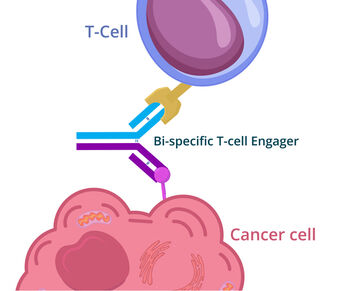
Tarlatamab belongs to a class of drugs called bispecific T-cell engagers, or BiTEs. These drugs bring immune cells called T cells into close contact with cancer cells.
Tarlatamab binds to two proteins. One, called DLL3, is found on the surface of many small cell lung cancer cells. The other, CD3, is found on T cells. By attaching to both proteins, tarlatamab acts as a bridge between the T cell and the cancer cell, helping the immune system recognize and attack the cancer.
Treating the Cancer Earlier
The phase 3 DeLLphi-305 trial included 563 patients whose cancer had not progressed after initial treatment with chemotherapy and durvalumab, an immunotherapy drug.
Researchers compared maintenance treatment with tarlatamab and durvalumab against durvalumab alone.
Patients who received the combination had a median overall survival of 21.1 months, compared with 12.7 months among those who received durvalumab alone. Median progression-free survival, the time patients lived without their cancer worsening, was 7.4 months with the combination and 1.9 months with durvalumab alone.
-

21.1 Months
Median overall survival of tarlatamab + durvalumab
-
12.7 Months
Median overall survival of durvalumab alone
The results suggest adding tarlatamab after initial treatment helps patients keep their cancer under control for longer. The approach does not replace initial chemotherapy and immunotherapy. Instead, tarlatamab is added during the maintenance phase for patients whose disease has not progressed.
“These results suggest we might be able to intervene earlier and give patients more time before their cancer progresses,” said Sonam Puri, MD, a medical oncologist at Moffitt Cancer Center.
Examining Tarlatamab in Real-World Care
Clinical trials measure how well a treatment works under controlled conditions. Real-world studies help researchers understand how a drug performs among a broader range of patients receiving care in everyday clinical settings.
Puri led a study through the ONWARD consortium examining commercial use of tarlatamab across 11 U.S. cancer centers. The study included 265 patients, 240 of whom had small cell lung cancer.
Among patients with available response assessments, 52.6% experienced disease control, meaning their cancer either shrank or did not grow during treatment. Researchers also reported a median overall survival of about eight months and median progression-free survival of 2.3 months.
“Clinical trials provide important information about how a treatment works, but they do not always reflect the full range of patients we see in everyday practice,” Puri said. “Real-world studies help us understand how these treatments perform in a broader patient population.”
The findings add to the evidence supporting tarlatamab as a treatment for small cell lung cancer. They also provide insight into how the drug performs outside the clinical trial setting.

“For patients with small cell lung cancer, controlling the disease for as long as possible is a major goal,” Puri said. “Our findings show tarlatamab is helping some patients achieve disease control in routine clinical care. Studying these outcomes helps us better understand the drug’s role in treatment.”
Moving tarlatamab into first-line maintenance treatment would give eligible patients access to the drug earlier in their treatment, with the goal of keeping cancer under control for longer.
 Medically reviewed by Sonam Puri, MD, Thoracic Oncology Department