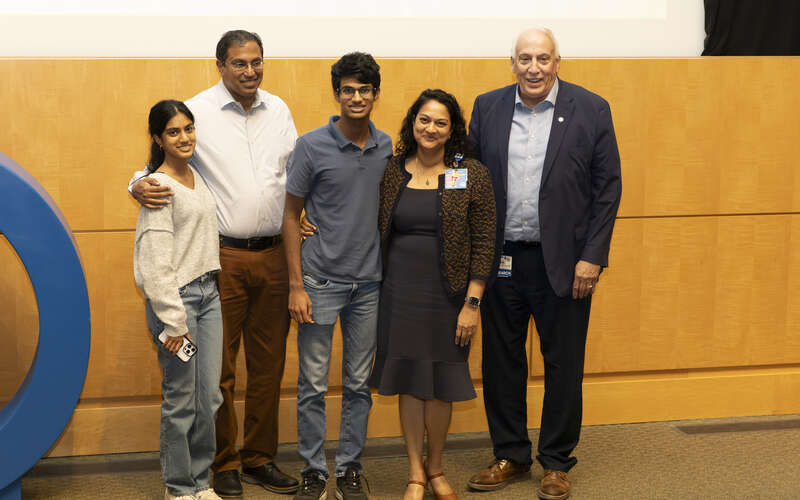

Susan Vadaparampil, PhD, Named Moffitt’s Researcher of the Year
Susan Vadaparampil, PhD, has spent much of her career focused on a central challenge in cancer prevention: ensuring that scientific advances reach the people who need them most.
In recognition of that work, Vadaparampil has been named the recipient of the Connie Mack Researcher of the Year Award, one of the highest research honors at Moffitt Cancer Center.
Congratulations to Susan Vadaparampil, PhD, MPH, (@SVadaparampil) on being named the Senator Connie Mack Researcher of the Year. Her leadership and dedication to advancing cancer prevention and survivorship research continue to make a meaningful impact for patients and families. pic.twitter.com/dakM4N4RIi
— Moffitt Cancer Center (@MoffittNews) March 8, 2026
The award recognizes investigators whose work has made significant contributions to cancer research and patient outcomes. For Vadaparampil, the honor is especially meaningful because it comes from colleagues across the institution where she has spent more than two decades building her career.
“It is very meaningful, particularly for somebody who has been at Moffitt for over 20 years and has seen the caliber of colleagues who receive this recognition,” Vadaparampil said. “Having admired and continue to admire their work, it makes me feel particularly honored.”
Vadaparampil is a nationally recognized leader in cancer prevention and population science, with research focused on improving access to genetic testing and increasing uptake of cancer prevention and early detection strategies. Her work focuses on the design and conduct of rigorous studies to test interventions for patients, providers and health care systems to increase uptake and implementation of breakthroughs in cancer science in real world clinical and community settings.
“Being at Moffitt has allowed me to feel a valued part of the bigger mission to prevention and cure cancer,” she said. “Being selected by my fellow researchers across all division shows me they recognize the contribution of population science research. It also highlights that they, too, understand the importance of research to identify and intervene specifically with groups that may not always benefit from some of the great advances we have in cancer prevention, care and survivorship.”
Advancing Cancer Prevention
One major focus of Vadaparampil’s work has been cervical cancer prevention and early detection by increasing use of the human papillomavirus, or HPV, vaccine, which can prevent several types of cancer.
She began studying HPV vaccination shortly after the vaccine became available in the late 2000s. Her research has explored ways to improve vaccination rates through provider education, parent outreach and system-level strategies designed to make vaccination easier to access.
“There are so few things where we can actually prevent cancer,” she said. “Being able to move the needle on HPV vaccination feels like a huge accomplishment for our state and for our nation.”

With cervical cancer screening, we have made major advances that allow for early identification and treatment of precancerous lesions.
“Both patients and providers may be deterred from using these advances due to a variety of factors at the individual and system level,” Vadaparampil said. “There are tremendous missed clinical opportunities that can be identified and improved through health care delivery research.”
Her work has helped inform strategies used by health systems and public health agencies to improve HPV vaccination coverage and cervical cancer screening.
Expanding Access to Genetic Testing
Vadaparampil has also made major contributions to research on inherited cancer risk, particularly related to genetic mutations that increase the likelihood of developing cancers such as breast and ovarian cancers.
Genetic testing can identify individuals at higher risk and allow them to take preventive steps or begin screening earlier. Yet many patients who qualify for testing never receive it.
Vadaparampil’s research examines the barriers that prevent genetic testing from reaching those patients.
“Sometimes providers are unaware that this testing is available or don’t have the confidence to offer it in their clinical setting,” she said. “Patients may also be unsure if testing is right for them or have concerns about genetic information.”
By studying how patients, providers and health systems interact, Vadaparampil’s work aims to develop practical strategies that help more people access potentially life-saving information.
A Focus on Impact
Throughout her career, Vadaparampil has remained focused on translating research discoveries into real-world cancer prevention.
“My goal has always been: How do we get new innovations developed at places like Moffitt to the people who need them?” she said.
That mission, she said, aligns closely with the collaborative culture at Moffitt.
“People here are collaborative, respectful and working toward a common goal, and seeing our patients every day inspires and motivates me to do more” Vadaparampil said. “Being in this unique setting has undoubtedly contributed to receiving this award.”