

Skip to nav Skip to content

Key Takeaways for Busy Providers

  • Moffitt began building its proton therapy program years before treating patients, intentionally recruiting proton-experienced professionals and developing specialized training across dosimetry, physics and treatment planning.
  • Proton therapy requires exceptional precision in simulation, treatment planning and dose delivery. Moffitt has invested in advanced CT simulation, specialized planning technology and extensive quality assurance processes to support each step.
  • Moffitt’s proton team practices treatment planning using real clinical scenarios, recreating existing patient plans as proton plans and reviewing them with experienced proton specialists.
  • Independent verification and daily, weekly and monthly quality checks are built into Moffitt’s proton therapy program to confirm that the dose calculated, planned and delivered aligns with treatment intent.
  • Proton therapy is not the right treatment for every patient. Moffitt’s depth across proton therapy, photon radiation and brachytherapy allows specialists to evaluate which radiation approach offers the greatest benefit for an individual patient.

Moffitt Cancer Center has invested in some of the most advanced proton therapy technology available. But the technology itself is only one part of what determines the quality of proton therapy. The greater differentiator is the human expertise behind it.

Years before Moffitt’s first proton patient, radiation oncology leaders began building the people, processes and infrastructure required to use the technology with exceptional precision. That preparation has touched nearly every part of the radiation oncology program, from recruitment and training to simulation, dosimetry, physics, treatment planning and quality assurance.

Our goal was not simply to acquire proton technology. It was to build a team capable of using it at the highest possible level.

If you would like a proton therapy consultation with a radiation oncologist, submit a new patient appointment request - no referral needed.
Schedule an Appointment

Proton Therapy Precision Begins Long Before Treatment

Proton therapy is highly complex. Because protons have mass and a positive charge, they interact with tissue differently than photons. Differences in tissue composition and density, such as lung tissue compared with bone, can affect how protons travel through the body and where they deposit their energy. That makes precision throughout the planning process critical.

Radiation treatment planning begins with simulation, where imaging is used to identify the treatment target and surrounding organs and tissues that should be protected. Moffitt invested in CT simulation technology at its Magnolia and Speros campuses with capabilities particularly valuable for proton therapy planning.

Dual-energy CT can provide additional information about tissue composition beyond what is available through conventional CT imaging. For proton therapy, that information can help the treatment team more precisely understand the tissues the proton beam will encounter as it travels toward the tumor. The technology provides the data. Experienced physicists, dosimetrists and radiation oncologists must know how to interpret and apply it.

Building Proton Expertise Years Before the First Patient

Moffitt began intentionally developing its proton therapy workforce approximately two years before the program’s launch.

Recruitment focused on professionals with direct proton therapy experience as well as emerging specialists who had received proton-specific training. Moffitt also recruited highly accomplished treatment-planning experts with the expectation that experienced team members would help develop the broader program.

Training for the proton program included dedicated time blocked for immersive proton education with subject-matter experts, with training rotations extended from four weeks to seven weeks. Team members took current patient treatment plans and recreated them as proton therapy plans, then reviewed their work directly with experienced proton planning specialists. This allowed dosimetrists to practice the complex decision-making involved in proton treatment planning before patient volume increased.

Moffitt also worked closely with proton therapy technology provider IBA on specialized education. During that process, the Moffitt team helped develop additional proton training modules to support areas not previously covered in the vendor’s training curriculum. The philosophy behind this preparation was simple: advanced expertise equivalent to years of experience should already be in place when patients arrive.

Treatment Planning Is Critical for Quality Proton Therapy

Proton therapy technology alone does not determine the quality of a treatment plan. The expertise behind the planning is critical. For each patient, dosimetrists, physicists and radiation oncologists must evaluate the tumor target, surrounding anatomy, tissue composition and treatment objectives. They must determine beam arrangements, calculate dose and account for the physical characteristics of proton therapy. The quality of those decisions matters.

Moffitt has placed significant emphasis on repeatedly creating, reviewing and refining proton treatment plans. This preparation also supports participation in clinical trials, which may require institutions to demonstrate their ability to plan and deliver radiation according to specific study requirements.

Detailed treatment comparisons can also play an important role in insurance authorization. Because proton therapy is more costly than some other forms of radiation, the treatment team may need to demonstrate why proton therapy offers a meaningful dosimetric advantage for an individual patient.

Quality Assurance Built Around Verification

Precision requires the willingness to check your work continually. That’s why Moffitt developed a comprehensive proton therapy quality assurance program that includes daily, weekly and monthly checks and balances. Proton physics expert Vladimir Feygelman, PhD, led the program, with additional specialists brought in to support implementation. The team uses independent verification processes rather than relying exclusively on internal calculations.

In one quality assurance process, the team calculates and delivers a radiation dose to a phantom designed to simulate aspects of the human body. The phantom is then independently evaluated to verify that the intended dose was calculated correctly, and the delivered dose matched the treatment plan. Separate phantom testing is used to validate CT simulation technology. During the approval phase of Moffitt's proton unit, samples irradiated in the proton room were assessed by the Imaging and Radiation Oncology Core (IROC) center in Houston, a national quality assurance center. This independent assessment confirmed the high precision of Moffitt's proton beam.

These layers of review are intentional. With a treatment designed to achieve millimeter-level precision, Moffitt has built checks and independent verification into the system surrounding the technology.

The Most Advanced Technology is Only as Good as the Team Using It

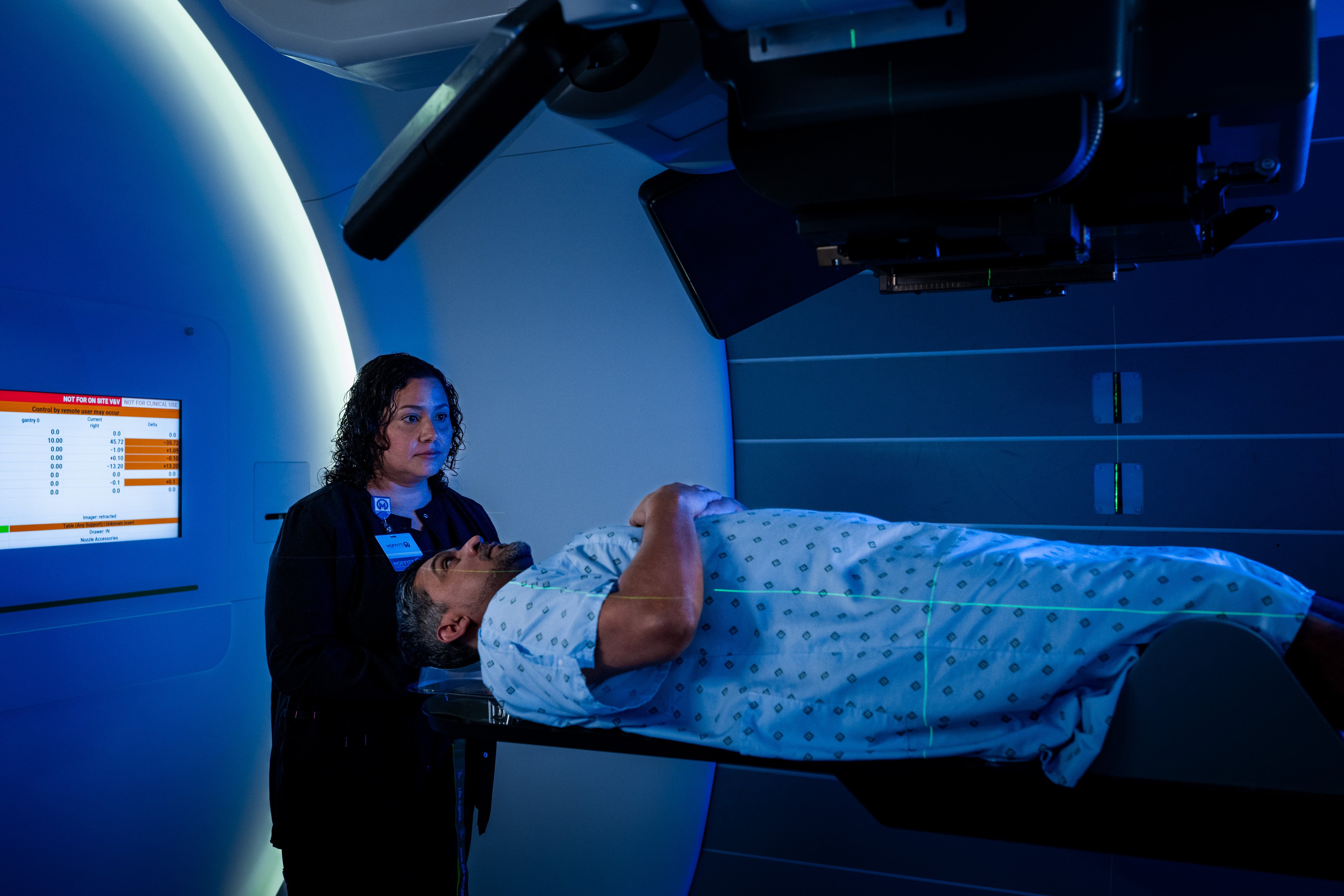
Moffitt selected an advanced proton therapy system that can rotate around the patient while the patient remains in the treatment position. But the investment extends far beyond the proton unit itself.

The program is supported by upgraded CT simulation technology, dual-energy imaging capabilities, specialized quality assurance equipment, treatment planning systems and a radiation oncology physics program that includes approximately 22 physicists. Together, these resources provide the infrastructure needed to support highly precise, individualized treatment planning.

Better simulation provides more detailed planning information, but the multidisciplinary team's expertise translates that information into a treatment plan. Building on years of experience working with disease-specific multidisciplinary teams, radiation oncologists outline the tumor, the tissue at risk of containing microscopic disease and the surrounding normal organs that should be protected from radiation. Experienced dosimetrists then translate that information into highly specialized treatment plans, while physicists evaluate the complex behavior of the proton beam and verify dose calculations and delivery. Finally, the radiation oncologist reviews the plan and confirms that it is the most appropriate approach for the patient.

Proton Therapy Is Not the Right Treatment for Every Patient

Part of proton therapy expertise is knowing when not to use it. Proton therapy may provide significant advantages for certain patients, particularly when reducing radiation exposure to surrounding healthy tissue is a critical treatment objective. In other clinical scenarios, another form of radiation may be more appropriate.

Moffitt’s radiation oncology program includes deep expertise in proton therapy, photon radiation and brachytherapy. This allows specialists to evaluate the available treatment approaches and determine which technology and treatment plan offer the greatest potential benefit for an individual patient. Radiation oncologists determine whether proton beam therapy is the most appropriate approach for the patient. Finally, the radiation oncologist reviews the treatment plan and confirms that the best plan has been developed for the patient.

For referring providers, the question does not have to be, “Does my patient need proton therapy?”

The more important question may be, “Could my patient benefit from a highly specialized radiation oncology evaluation?”

At Moffitt, the answer is determined not by the newest machine, but by the physicians, physicists and dosimetrists who understand how to use the full range of radiation technologies with precision.