
Proton Therapy vs. Traditional Radiation Therapy for Head and Neck Cancer
A diagnosis of head or neck cancer can raise many questions about treatment options and possible side effects. Radiation therapy is often an important part of care for cancer affecting the mouth, throat, nasal cavity, salivary glands or nearby structures. In addition to traditional radiation therapy, some patients may have access to proton therapy.
Both treatment approaches are designed to destroy cancer cells, shrink tumors and reduce the risk of recurrence. However, each works differently and can offer distinct advantages depending on the patient’s diagnosis, tumor location and overall treatment goals.
Understanding traditional radiation therapy
Conventional radiation therapy, also known as photon therapy or X-ray radiation therapy, uses high-energy X-ray (photon) beams to damage cancer cells. It has been a standard treatment for head and neck cancer for decades and remains a highly effective option for many patients.
One of the most frequently used forms of traditional radiation treatment for head and neck cancer is intensity-modulated radiation therapy (IMRT). IMRT uses computer-guided planning to shape the X-ray beams around complex anatomy and protect nearby structures whenever possible.
During each treatment session, radiation beams are generated by an external machine (linear accelerator) and precisely directed at the tumor from multiple angles. Through advanced planning techniques, the radiation oncologist can minimize exposure to healthy tissues while delivering a therapeutic dose to the cancer.
Conventional radiation therapy may be recommended for head and neck cancer in several clinical scenarios, including:
- After surgery to treat any remaining microscopic cancer cells and help reduce the risk of recurrence
- In combination with chemotherapy for enhanced treatment effectiveness
- As a primary therapy if surgery is not feasible
- To relieve symptoms caused by advanced cancer
Although modern photon-based radiation delivery techniques are highly sophisticated, one drawback of this treatment approach is that the X-ray beams will continue to travel through the body after passing through the tumor. This means some healthy tissues beyond the treatment site may be exposed to radiation.
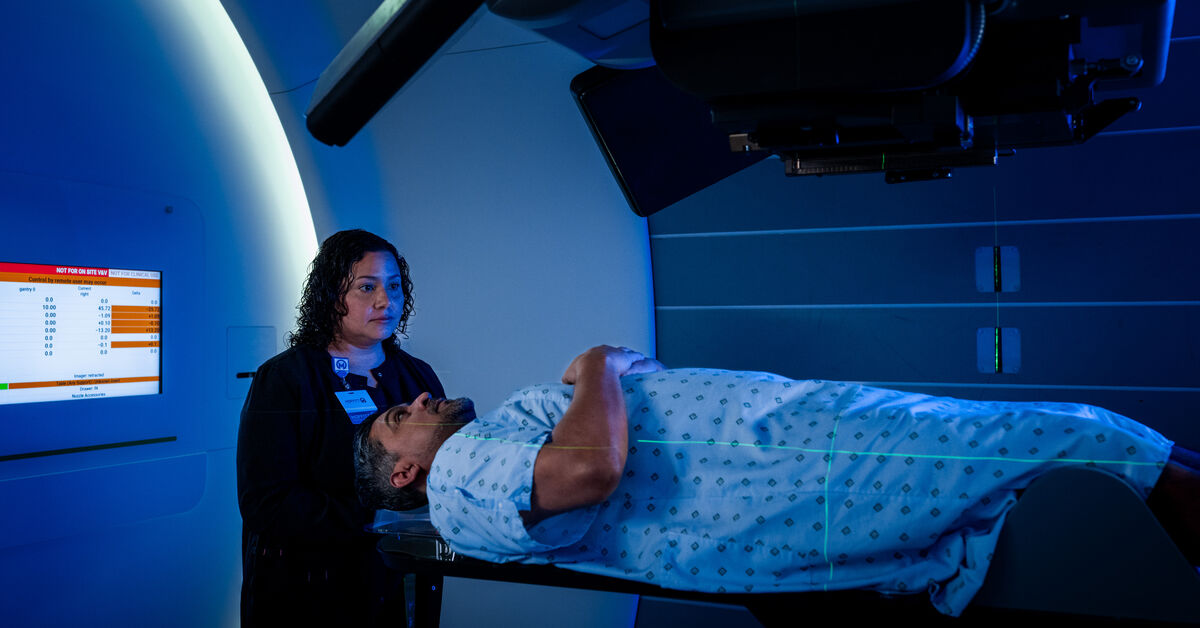
What is proton therapy?
Proton therapy is an advanced form of radiation therapy that uses positively charged particles (protons) instead of X-rays (photons) to treat cancer. Like traditional radiation therapy, proton therapy damages cancer cells and interferes with their ability to grow and divide. The key distinction lies in the physical properties of the proton beams, which allow radiation to be deposited more precisely within the targeted area.
Unlike photons, protons can be programmed to stop traveling after reaching a specific depth within the body. As a result, most of the radiation energy is released directly within the tumor, with minimal radiation extending beyond the targeted area. This unique property is known as the “Bragg peak.”
Why precision treatment is especially important for head and neck cancer
Head and neck cancer often develops near delicate structures that control essential functions, such as the:
- Brainstem
- Eyes and optic nerves
- Jawbone
- Oral cavity
- Salivary glands
- Spinal cord
- Swallowing muscles
- Tongue
- Voice box (larynx)
Because these structures are situated close together in a relatively small area, radiation therapy for head and neck cancer must be delivered with exceptional accuracy. Even with carefully planned treatment, some nearby healthy tissue may still be exposed to radiation energy, which can lead to side effects during or after therapy.

Possible side effects of radiation therapy for head and neck cancer include:
- Changes in taste sensation
- Dental complications
- Difficulty swallowing
- Dry mouth
- Fatigue
- Jaw stiffness
- Mouth sores
- Skin irritation
- Vocal hoarseness
The type and severity of the side effects can vary depending on the tumor’s location and stage, the total radiation dose and the treatment technique. Advanced technologies that reduce unnecessary radiation exposure to healthy tissue may help lower the risk or severity of certain complications while better preserving important functions, such as speech, swallowing and saliva production.
This is one reason why proton therapy is becoming an increasingly important treatment option for head and neck cancer. Its heightened precision can help protect nearby healthy tissues and critical structures while still delivering a highly effective dose of radiation directly to the tumor.
Key differences between proton therapy and traditional radiation therapy
Both conventional radiation therapy and proton therapy can be highly effective for treating head and neck cancer. However, the two approaches differ in terms of the type of radiation energy used and the way it is deposited within the body. More specifically, key differences include:
- Radiation source – Traditional radiation therapy uses X-rays; proton therapy uses proton particles
- Radiation path – X-ray beams continue to travel beyond the tumor site; proton beams stop at the tumor target
- Exposure to nearby tissues – Traditional radiation therapy has an exit dose that exposes healthy tissues; proton therapy reduces radiation exposure beyond the tumor
- Treatment precision – X-ray radiation therapy can be highly targeted with advanced planning; proton therapy features an extremely precise dose delivery
- Availability – Traditional radiation therapy is widely accessible; proton therapy is currently available only through specialized treatment centers
- Potential side effects – Photon therapy can affect nearby healthy structures; proton therapy may reduce some treatment side effects in select patients
Conventional radiation therapy remains an excellent and well-established treatment option supported by decades of clinical research and successful outcomes. While proton therapy is not necessarily the best choice in every situation, it may offer important advantages for treating tumors located near sensitive anatomy in the head and neck, where preserving healthy tissues is especially important.
For many head and neck cancers, this added precision can help protect structures involved in speech, swallowing, taste, hearing and vision while still delivering a highly effective dose of radiation to the tumor. As a result, proton therapy is becoming an increasingly important option for carefully selected patients requiring highly targeted treatment.

Who may benefit from proton therapy?
Proton therapy may be especially beneficial for a patient with a tumor located near one or more critical organs, nerves or other sensitive structures, where protecting nearby healthy tissues and preserving important bodily functions are major treatment priorities. In head and neck cancer care, this can include cancers involving the:
- Base of the tongue
- Eye region
- Nasal cavity
- Nasopharynx
- Oropharynx
- Salivary glands
- Sinuses
- Skull base
Proton therapy may also be considered in situations where:
- Radiation therapy must be delivered near a previously treated area
- A high radiation dose is needed to effectively treat the tumor
- Long-term preservation of healthy tissues and functions is a top priority
- The tumor is located close to the spinal cord, brainstem, optic nerves or other critical anatomy
Every case is unique, however, and proton therapy is not necessarily the best option for every patient or every tumor type. Factors such as the size, location and stage of the cancer, along with the patient’s overall health and treatment goals, all play an important role in determining whether proton therapy or another form of radiation treatment may be most appropriate.
Possible side effect differences
Research suggests that proton therapy may help reduce radiation exposure to nearby healthy tissues in certain head and neck cancer cases. Because of its heightened precision, proton therapy can limit unnecessary radiation delivery to structures involved in swallowing, saliva production, taste and other essential functions. As a result, some patients may experience fewer or less severe side effects compared with traditional radiation therapy.
For example, proton therapy may reduce the risk of:
- Changes in taste sensation
- Difficulty swallowing
- Feeding tube dependence
- Long-term complications involving nearby organs and tissues
- Radiation exposure to the jawbone
- Severe dry mouth
Even so, proton therapy can still cause side effects because radiation is still being delivered to the body. During treatment, side effects may include fatigue, skin irritation, mouth soreness or discomfort when swallowing.
It is also important to recognize that outcomes can differ from person to person. While some patients may experience meaningful quality-of-life benefits with proton therapy, others may achieve similar results with advanced photon-based techniques, such as IMRT. Treatment recommendations must be carefully individualized to balance effective cancer control with preservation of healthy tissues and long-term function.
 Florida's First NCI-designated Comprehensive Cancer Center
Recognized for its scientific excellence, Moffitt is the state's longest-established National Cancer Institute-designated Comprehensive Cancer Center.
The importance of individualized treatment planning
Choosing between proton therapy and traditional radiation therapy is not a one-size-fits-all decision. Typically, the radiation oncologist will use detailed imaging, tumor mapping and advanced planning software to determine which technique is more likely to safely and effectively treat the cancer while protecting healthy tissues. Additionally, treatment will be planned with input from a multispecialty team, which may include:
- Head and neck surgeons
- Medical oncologists
- Nutritionists and dietitians
- Pathologists
- Radiologists
- Speech and swallowing specialists
- Supportive care providers
This collaborative approach can help ensure the patient receives recommendations tailored to their unique diagnosis and treatment goals.
Questions the patient may want to ask
A patient who is considering radiation therapy for head and neck cancer may benefit from discussing the following questions with their healthcare team:
- Am I a candidate for proton therapy?
- What are the goals of radiation treatment in my case?
- What side effects are most likely with each option?
- Could proton therapy help protect nearby organs or tissues?
- How many treatments will I need?
- Will I receive chemotherapy or surgery as part of my treatment plan?
- What supportive care services will be available during treatment?
Understanding the potential benefits and limitations of each radiation treatment option can help the patient feel more informed and confident throughout the decision-making process.
Benefit from world-class care at Moffitt Cancer Center
Moffitt’s comprehensive Head and Neck Oncology Program provides individualized care for patients with head or neck cancer using advanced technologies and evidence-based approaches. As a National Cancer Institute (NCI)-designated Comprehensive Cancer Center, we offer research-backed treatment plans designed and delivered by a multispecialty team. Whether the patient is exploring traditional radiation therapy, proton therapy or another treatment option, our goal is always the same: to ensure effective cancer care and the best possible quality of life.
If you would like to learn more about proton therapy for head and neck cancer, you can request an appointment with a specialist in the Radiation Oncology Program at Moffitt by calling 1-888-663-3488 or submitting a new patient registration form online. We do not require referrals.