This fellowship is not accredited by the ACGME and does not lead to certification by the American Board of Colon and Rectal Surgery or the American Board of Surgery. It is an advanced clinical fellowship approved and overseen by Moffitt Graduate Medical Education. Fellows are Moffitt employees and receive salary and benefits according to postgraduate year. Application information
Colorectal Surgical Oncology Fellowship
The Colorectal Surgical Oncology Fellowship at Moffitt Cancer Center is a 12-month clinical fellowship based in the Department of Gastrointestinal Surgical Oncology and Gastroenterology. It is designed for surgeons who have completed colon and rectal surgery or surgical oncology training and want to build a practice centered on colorectal cancer.
The fellow joins the colorectal surgical oncology faculty as a senior trainee and participates in every stage of care: initial evaluation and staging, multidisciplinary treatment planning, the operation itself and surveillance. The year emphasizes robotic, laparoscopic and open pelvic surgery, rectal cancer organ preservation and watch-and-wait selection, extended multivisceral resections, cytoreductive surgery with hyperthermic intraperitoneal chemotherapy (CRS/HIPEC), transanal and endoscopic approaches, management of hereditary and young-onset colorectal cancer, as well as anal dysplasia and anal cancers.
-
Length
12 Months
-
Positions
1 per year
-
Start date
August 1
-
Application deadline
October 31
Moffitt performs approximately 14,000 surgical cases and sees more than 30,000 new patients each year. Care is organized by disease site, so medical oncology, radiation oncology, rectal-dedicated radiology, gastrointestinal pathology, advanced endoscopy, genetics and supportive care are built into the daily work of the service rather than consulted from outside it. Moffitt has been continuously accredited by the American College of Surgeons Commission on Cancer since 1989, and the Rectal Cancer Program is structured to the standards of the National Accreditation Program for Rectal Cancer.
Program Aims
Upon completion of the fellowship, the graduate will be able to:
 Lead multidisciplinary decision-making - Integrate MRI staging, pathology, systemic therapy and radiation sequencing into an individualized plan for colon, rectal and anal cancer at every stage, including recurrent and metastatic disease.
 Select and follow organ-preservation candidates - Determine neoadjuvant treatment approaches, perform response assessment and watch-and-wait surveillance protocols and recognize regrowth and salvage indications.
 Operate independently across approaches - Perform robotic, laparoscopic and open colectomy and proctectomy with total mesorectal excision, sphincter-preserving low anastomoses and abdominoperineal resection.
 Manage locally advanced and recurrent pelvic disease - Plan and perform multivisceral and exenterative resections with colleagues in urology, gynecologic oncology and plastic surgery.
 Treat peritoneal metastases - Evaluate and perform cytoreductive surgery and HIPEC.
Practice as an academic surgeon - Design and complete clinical research, present at national meetings, teach residents and fellows, and contribute to quality and accreditation programs.
Meet Our Program Leaders
 Program Director
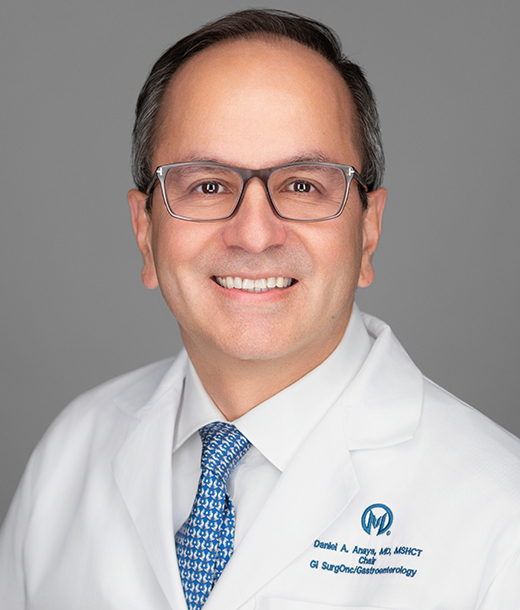 Department Chair
Daniel A. Anaya, MD
Gastrointestinal Surgical Oncology and Gastroenterology Department
GME Program Administrator
Jamie Harrington, C-TAGME
Jamie.Harrington@Moffitt.org