

Immunocellular Therapy Offers Hope for Patients With Leptomeningeal Disease
Key Takeaways:
- Moffitt Cancer Center researchers are investigating dendritic cell immunotherapy, which uses a patient’s own immune cells to recognize and attack cancer cells in the cerebrospinal fluid
- Results from a phase 1 clinical trial involving 15 patients with breast cancer-associated leptomeningeal disease show encouraging signs
- Advancement into phase 2 is exploring combination therapies and studying biological markers to better predict treatment response and develop more personalized approaches
Leptomeningeal disease (LMD) remains one of the most challenging complications of cancer to treat but recent research is offering new hope for patients.
LMD occurs when cancer cells spread into the leptomeninges, the delicate layers of tissue surrounding the brain and spinal cord and enter the cerebrospinal fluid. The disease is aggressive and often carries a poor prognosis.

Peter Forsyth, MD
However, researchers at Moffitt Cancer Center continue to explore new ways to fight LMD, including approaches that harness the body’s own immune system. One approach involves immunocellular therapy using dendritic cells, a type of immune cell that educates the body, recognizes threats and coordinates an immune response.
“If you’re going to win a war, you can’t fight one battle at a time. You have to fight on multiple fronts, and there are all sorts of different strategies,” said Peter Forsyth, MD, chair of Moffitt’s Neuro-Oncology Department.
Training Immune Cells
Moffitt researchers recently completed a phase 1 clinical trial enrolling 15 patients with breast cancer-associated LMD.

Patient Heather Curley says a clinical trial has given her hope after her LMD diagnosis.
The treatment involves collecting a patient’s own dendritic cells and exposing them to peptides associated with the tumor, including HER2 and HER3, acting as messengers that alert the immune system when something is wrong.
“We’re educating the immune cells and showing them these are the proteins they need to attack,” Forsyth said.
The cells are administered directly into the patient’s cerebrospinal fluid through an intrathecal injection, bringing the treatment into the same environment where the cancer is spreading.
Encouraging Early Results
The primary goal of the phase 1 trial was to establish a safe dose and evaluate potential side effects. While the treatment can cause significant headaches and temporary inflammation of the meninges, Forsyth says researchers have also observed encouraging signs of activity.
The study found that at least six of the 15 patients enrolled appear to be living longer than expected.
The average survival of approximately 29 months is encouraging compared with historical outcomes for patients with LMD. Among them is a 64-year-old woman who has surpassed one year of survival following treatment.

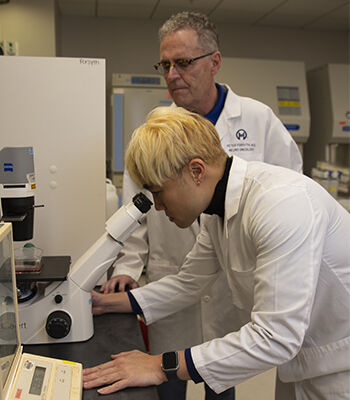
“As scientists, we rarely have the opportunity to see the impact of our research in real time. Being able to watch our work move from bench to bedside and make a meaningful difference in patients’ lives is truly a gift,” said Vincent Law, a senior neuro-oncology research specialist in Forsyth's lab.
 Advancing Treatment
Through ongoing research, Moffitt researchers have contributed to advances in LMD treatment.
Beyond evaluating the treatment itself, researchers are also studying why some patients respond while others do not.
Forsyth says the team is analyzing patients’ cerebrospinal fluid to identify biological signatures that could help predict who is most likely to benefit from treatment. The goal is to use those discoveries to develop more personalized approaches and identify better options for patients who may not respond to current therapy.
With phase 2 of the trial underway, researchers are exploring combinations of dendritic cell therapy with additional treatments. They hope combining different approaches will produce a stronger and more lasting response.
Moffitt researchers are also investigating other cellular immunotherapy approaches for different cancer types, including melanoma-associated LMD. In a separate preclinical study, researchers evaluated CAR T cells engineered to recognize TRP1, a protein expressed in a subset of melanoma-associated LMD cases.
Together, the studies reflect a broader effort to better understand LMD and develop new treatment approaches for patients with different types of cancer.
For Forsyth and researchers, the work represents an opportunity to keep pushing forward in a disease that has historically offered patients few options.
“We need to find ways to cure these things,” Forsyth said.
A novel dendritic cell therapy shows early promise for breast cancer leptomeningeal disease. At #SNO26, Moffitt’s Peter Forsyth, MD (@PeterForsyth27), discusses research findings showing immune activation, manageable toxicity and a median overall survival of 16.2 months. #MoffittSNO26
— Moffitt Cancer Center (@MoffittNews) November 15, 2026
 Medically reviewed by Peter Forsyth, MD, Neuro-Oncology Program.