
Lung Cancer Metabolism P01: Faculty
 Elsa R. Flores, Ph.D. - Senior Member and Project #1 Leader
The overarching interest of the Flores laboratory is to gain a mechanistic understanding of the p53 family of tumor suppressor genes, p53, p63, and p73, in cancer and metastasis to generate targeted therapies for p53 deficient and mutant tumors. Through the use of genetically engineered mouse models, genomics and proteomics approaches, the Flores laboratory has found that this gene family plays a central role in tumorigenesis and metastasis. Using this approach, the Flores laboratory has identified several compounds to target the p53 pathway therapeutically. In Project #1 of the Lung Cancer Metabolism Program, Dr. Flores and her team will study the metabolic and immune-related functions of the p53 family in the pathogenesis of lung adenocarcinoma and small cell lung cancer and aims to target the p53 pathway therapeutically.

Marcelo G. Bonini, Ph.D. - Senior Member and Project #1 Co-Leader
The Bonini lab is interested in the mechanisms connecting the decline of the energetic metabolism that occurs during aging with aging-related diseases, cancer being a prime example. Dr. Bonini's research focuses on how a switch in the functioning of mitochondria to promote reactive oxygen species production over ATP changes the biophysical microenvironment of the cell, with particular emphasis in the nucleus. He also aims to determine how these metabolic changes impact chromatin structure and gene expression.
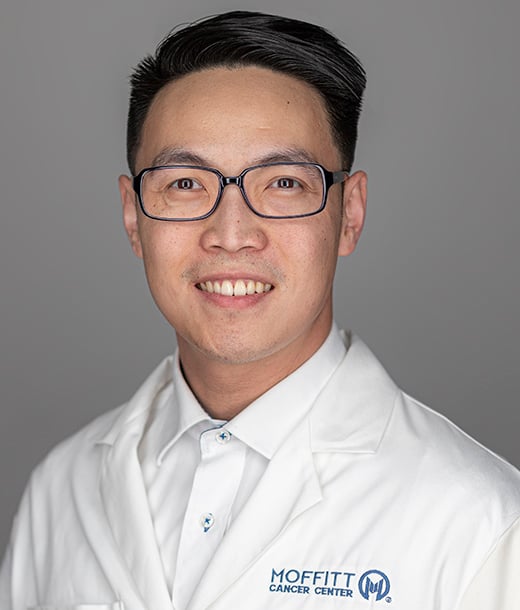
Duy T. Nguyen, Ph.D. - Assistant Member and Project #1 Co-Leader
Dr. Nguyen's research is dedicated to investigating the biophysical properties of solid tumor microenvironments. He seeks to understand the dynamic interactions among cancer cells, the immune system, and the important role of extracellular mechanics in driving tumor progression.
 Gina M. DeNicola, Ph.D. - Associate Member and Project #2 Leader
The DeNicola lab uses genetically engineered mouse models and mass spec metabolomics to investigate the consequence of NRF2 deregulation in cancer. Dr. DeNicola will lead Project #2 of the Lung Cancer Metabolism Program, which focuses on the regulation and role of cysteine metabolism in lung adenocarcinoma. In addition, Dr. DeNicola provides her knowledge and expertise in metabolomics to inform the research of all four projects.
 Eric B. Haura, M.D. – Senior Member and Project #3 Co-Leader
Dr. Haura is a thoracic oncologist at Moffitt Cancer Center who cares for patients with advanced lung cancer. His laboratory utilizes integrative discovery proteomics, metabolomics, and genomics to study the underlying biology of lung cancer. Using this approach, Dr. Haura and his team aim to produce a more complete view of the tumor architecture and the major signaling proteins driving lung tumor growth and survival. Dr. Haura is a co-leader for Project #3, which is centered on targeting metabolic circuits that represent novel therapeutic opportunities in small cell lung cancer.

Uwe Rix, Ph.D. – Senior Member and Project #3 Co-Leader
Dr. Rix has expertise in chemical proteomics, a powerful technology to identify targets of small molecule drugs/probes and launch mechanistic studies to elucidate their cancer-specific contexts and better understand cancer signaling networks.
 Paulo C. Rodriguez, Ph.D. – Senior Member and Project #4 Leader
The long-term goal of Dr. Rodriguez’s research is to develop innovative strategies that restore protective immunity in cancer through targeting primary metabolic mechanisms regulating immunosuppressive pathological myelopoiesis and signals driving T cell dysfunction in tumors. His research aims to create strategies that render T cells highly resistant to the immunosuppressive tumor microenvironment. As the leader of Project #4, Dr. Rodriguez will identify an elusive metabolic mechanism centrally governing the function and expansion of myeloid-derived suppressor cells (MDSC) in lung tumors, which could significantly increase the efficacy of promising approaches for cancer immunotherapy.

Alex M. Jaeger, Ph.D. – Associate Member and Project #4 Co-Leader
Dr. Jaeger's research is focused on understanding the fundamental relationships between gene expression and protein metabolism that shape antigen presentation in the tumor microenvironment. Using inducible affinity tags, Dr. Jaeger is able to isolate tumor specific MHC-I peptides from genetically engineered models of pancreatic and lung adenocarcinomas, using this information to profile the evolution of the immunopeptidome through tumor progression.
Lung Cancer Metabolism Working Group